
How to Stop a Counteroffer From Losing Your Executive Hire
A counteroffer looks like a money problem but is really a process problem. Here is the playbook to protect an executive hire from the first interview to the first day.

You spent three months on the search. The shortlist was strong, the finalist was right, and last week they said yes. Then their current employer heard they were leaving, and now the yes is soft. This is the moment most senior hires are quietly lost, and it is also the most preventable one. A counteroffer looks like a money problem, but it is almost always a process problem that started long before the offer went out.
This guide is the playbook Talione uses to protect an executive hire from the counteroffer, from the first conversation through the first day on the job.
The short answer
You do not stop a counteroffer at the offer stage. You stop it in interview one, by surfacing why the candidate is really leaving, naming the counteroffer out loud, keeping the process moving, and staying close to them through resignation and the first day. A managed close beats a bigger number almost every time.
- Nearly a quarter of senior candidates wobble after a verbal yes, most often when a counteroffer lands.
- Money is rarely the real reason a leader leaves, so a money counteroffer rarely fixes it for long.
- Name the counteroffer early, then pre-close and pre-board so the yes is already tested before the offer goes out.
- Speed protects the hire: every extra week of silence invites second thoughts.
On this page
- Why do executive candidates accept a counteroffer after saying yes?
- Do accepted counteroffers actually work?
- How do you surface the real reason a candidate is leaving?
- When should you name the counteroffer in the process?
- How do you keep momentum so the offer does not stall?
- What is a pre-close conversation and how do you run it?
- How does pre-boarding hold the yes?
- Frequently asked questions about executive counteroffers
Why do executive candidates accept a counteroffer after saying yes?
Because saying yes to you and actually leaving are two different decisions, and the second one is far harder. A verbal acceptance is made in the excitement of a new opportunity. Resigning is made in a room with a boss who suddenly pays attention, a team the candidate feels responsible for, and years of built-up loyalty and inertia. The counteroffer lands right in that gap.
Senior leaders are especially exposed here. They are harder to replace, so their employer fights harder to keep them. They also have more to walk away from: equity that is still vesting, a reputation tied to unfinished work, relationships with a board. When the counteroffer arrives, it rarely reads as a raise. It reads as being wanted, and that is a powerful pull for someone who had convinced themselves they were undervalued.
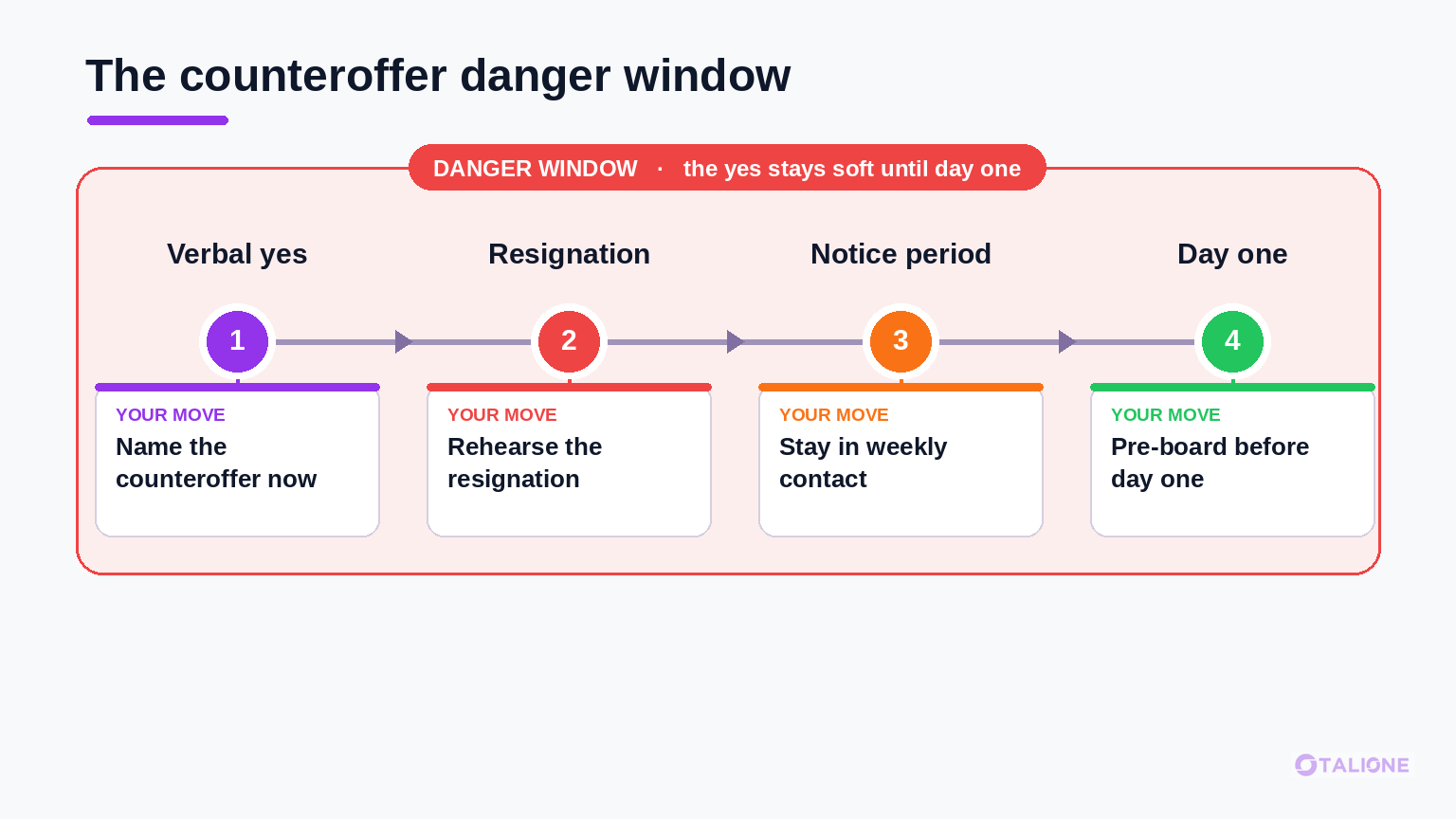
The trap for the hiring company is treating the yes as the finish line. In reality the highest risk period of the entire search opens the moment the candidate accepts and runs until they physically start. If nobody is managing that window, you are hoping, not closing.
Do accepted counteroffers actually work?
Rarely, and both sides usually know it. Directionally, a large share of leaders who accept a counteroffer are gone within twelve to eighteen months anyway, because the counteroffer fixes the number without fixing the reason they were looking. The frustrations that drove them to take your calls, a stalled mandate, a broken relationship with a manager, no path to the next level, are still there the following Monday. Now they are also the person who tried to leave.
This matters for how you compete. If you frame the contest as your offer versus their counteroffer, you are fighting on the one axis, cash, where an incumbent employer can usually match or beat you instantly. If you frame it as the reason they wanted to leave versus a raise that does not touch that reason, you are competing on ground the counteroffer cannot reach.
A counteroffer is not a bidding war you lost. It is a signal that the close was left to chance.
How do you surface the real reason a candidate is leaving?
Ask early, ask directly, and keep asking until you get past the polite answer. The first reason a candidate gives, usually money or a vague desire for a new challenge, is almost never the whole story. Your job in the early interviews is to find the real driver, because that is the thing a counteroffer will have to overcome later.
Useful questions to work in naturally:
- What would have to change in your current role for you to stay? Listen for whether money is even on the list.
- What is the one thing you want to do next that you cannot do where you are now?
- If you handed in your notice tomorrow, what would your manager say to keep you, and would any of it change your mind?
That last question is a counteroffer rehearsal. If the candidate cannot imagine anything their employer could say, the reason to leave is strong. If they hesitate, you have found the soft spot early, while you still have time to work with it, rather than on the day the counteroffer lands.
When should you name the counteroffer in the process?
In the first serious interview, not the last. Naming the counteroffer early does two things. It signals that you have done this before and you are not naive about how their employer will react. And it lets the candidate pre-decide, out loud, how they will handle it, long before the emotional pressure of resignation day.
The conversation is simple. Something like: a leader as strong as you will almost certainly get a counteroffer, so let us talk now about what you will do when it comes. Then let them think it through with you. A candidate who has said, in week two, that no counteroffer would change their decision is far harder to pull back in week eight. You have moved the decision from a high pressure moment to a calm one.
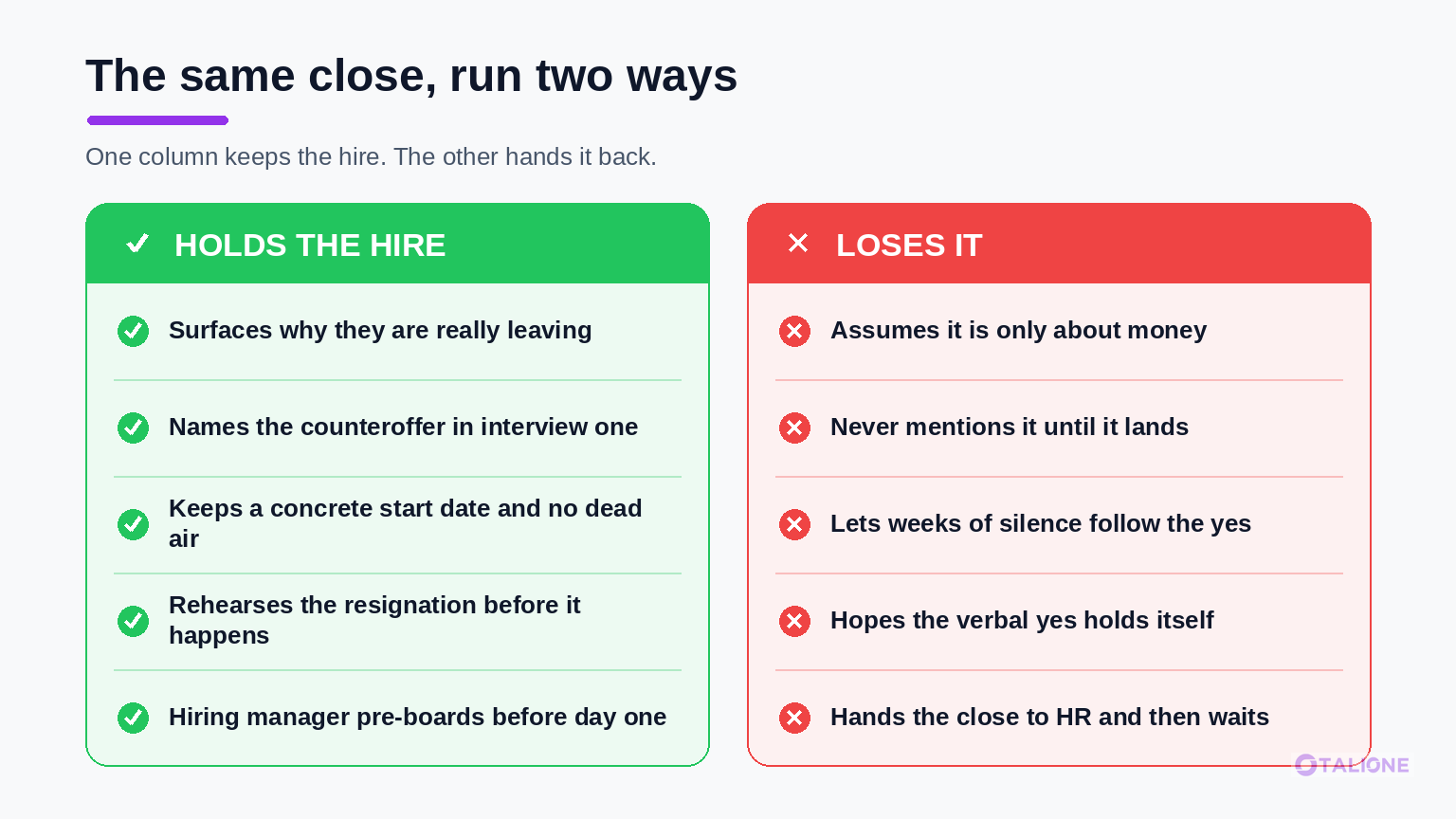
The playbook below shows the difference between a close that anticipates the counteroffer and one that hopes to avoid it.
How do you keep momentum so the offer does not stall?
Treat dead air as the enemy. The longer the gap between a candidate's yes and their start date, the more room there is for doubt, for a counteroffer to be prepared, and for a competing process to catch up. Most counteroffers do their damage in the silence between stages, when the candidate is left alone with second thoughts and a nervous current employer.
Protecting momentum is mostly operational discipline:
- Line up approvals and the compensation package before the final interview, so the offer can go out within a day of the decision, not a week.
- Give a real, near start date at the moment of acceptance. A concrete first day makes the move feel real and closes the open-ended window a counteroffer thrives in.
- Keep the candidate connected. A short note from the future manager, an intro to a peer, a copy of the first ninety day plan. Presence, not pressure.
Speed is not about rushing the candidate. It is about removing the empty stretches where a hire goes cold. If you want a sense of how the full timeline should run, see our guide on how long executive search takes in Canada.
What is a pre-close conversation and how do you run it?
A pre-close is the conversation you have before you extend the formal offer, to confirm the candidate is truly ready to accept and to defuse anything that could unravel it. Done well, the written offer becomes a formality, because the real yes already happened in a candid conversation.
Run it in three moves. First, confirm the terms verbally and get an explicit yes to the number, the title, and the start date, so there are no surprises when paper arrives. Second, walk through the resignation itself: how they will do it, when, and what their manager is likely to say. Third, close the loop on the counteroffer one more time, now that it is real: when they offer you more to stay, what is your answer? A candidate who says it out loud to you has largely made the decision.
This is also where total value beats base salary. If the counteroffer is purely cash, remind the candidate of the whole picture: the mandate, the scope, the growth, the reason they started looking. For how to build an offer that stands up to a counteroffer on more than money, see our guide to executive compensation in Canada.
How does pre-boarding hold the yes?
Pre-boarding keeps the new leader engaged between the signed offer and the first day, so they arrive committed rather than second-guessing. This is the stretch where a quiet candidate is most vulnerable, and where most companies go silent because, on paper, the hire is done.
The most powerful move is direct contact from the hiring manager, not HR. A short call to say the team is genuinely excited, share early context, and invite a first question does more to hold a candidate than any clause in a contract. Add a light touch every week or two: a coffee with a future peer, the first ninety day plan, an invitation to a relevant meeting as an observer. Each one makes leaving harder and the new role more real.
Pre-boarding also sets up the hire to actually succeed once they start, which is the real point. A leader who is welcomed and oriented before day one ramps faster and stays longer. Our executive onboarding plan for the first 90 days picks up exactly where pre-boarding ends.
Closing a senior hire you cannot afford to lose?
Talione runs the full close on executive searches, from surfacing the real motivation to pre-boarding, on a zero upfront, success based model. We are paid when your leader starts, not before.
Talk to Talione about your searchFrequently asked questions about executive counteroffers
Should we just match the counteroffer to win the candidate?
Usually not. Turning it into a bidding war rewards the behaviour and often still loses the hire, because the incumbent can keep raising. Compete on the reason they wanted to leave and on total value, not on out-bidding a raise.
What is the single best predictor that a candidate will resist a counteroffer?
A clear, specific reason for leaving that has nothing to do with money, stated early and repeated consistently. Candidates who leave for a mandate or a growth path are far more counteroffer-proof than those who leave for a number.
How soon should the offer go out after a verbal yes?
As close to same day as you can manage. Prepare approvals and the package before the final interview so the formal offer follows the decision within a day, not a week. Delay is where counteroffers get organised.
Is it pushy to talk about the counteroffer before we have even made an offer?
No, senior candidates read it as competence. It shows you understand how their world works and that you are managing the process, which is reassuring, not aggressive.
What if the candidate has already accepted the counteroffer?
Stay respectful and keep the door open. A meaningful share of counteroffer acceptances unravel within a year. A calm check-in a few months later, with no pressure, often finds a candidate ready to talk again.
Can a search firm actually manage all of this?
Yes, and it is one of the clearest reasons to use one. A firm that runs the close as a discipline, surfacing motivations, naming the counteroffer, pre-closing, and pre-boarding, protects the hire in ways an overloaded internal team often cannot. See our principles for hiring senior talent in Canada.
Hiring senior talent in Canada?
Talione helps companies hire 4× faster with zero upfront costs. Let's find your next great hire.
Hire TalentRelated Posts

When to Hire a CFO in Canada: Signs, Timing, and the Fractional Bridge
The real triggers to hire a CFO in Canada, how the role differs from a controller or VP Finance, when a fractional bridge makes sense, and what to screen for.
Fractional, Interim, or Full-Time? Choosing the Right Executive Leadership Model
Fractional, interim, or full-time executive? Compare cost, timeline, and fit, and learn how to choose the right leadership model for your senior gap.
Executive Reference Checks: The Questions That Actually Predict Success
Reference checks are where most senior hires are quietly saved or lost. Who to call, the questions that predict success, and the red flags to chase before you make the offer.