
When to Hire a CFO in Canada: Signs, Timing, and the Fractional Bridge
The real triggers to hire a CFO in Canada, how the role differs from a controller or VP Finance, when a fractional bridge makes sense, and what to screen for.


Founders rarely ask whether they need a CFO. They ask it the week a board member wants a three-year model, or the month a lead investor asks for a data room, and by then the honest answer is that they needed one a quarter ago. Timing the first CFO hire is one of the highest-leverage decisions a Canadian growth company makes, and it is almost never about a single revenue milestone.
This guide lays out the real triggers, how a CFO differs from a controller or a VP Finance, when a fractional CFO is the smarter first move, and what to screen for so the hire holds. The goal is simple: hire finance leadership on purpose, on a clear brief, before a raise or a quarter forces your hand.
TL;DR
Hire a CFO when your decisions outgrow your data, not when you hit a revenue number. The clearest triggers are an upcoming raise, board questions you cannot answer with confidence, and cash-runway decisions that need real scenario planning. Many Canadian founders bridge with a fractional CFO first to prove the need, then hire full-time on a tested brief.
- Revenue alone is a weak signal. Complexity, capital, and unanswered board questions are the real ones.
- A controller keeps the books right, a VP Finance runs the engine, a CFO owns capital and strategy. Do not conflate them.
- A fractional CFO is a low-risk bridge that also writes the permanent brief.
- Screen a first CFO for fundraising, defensible models, and diligence, not just accounting depth.
- The wrong or late CFO hire can cost you a raise or a quarter, so treat timing as a strategic decision.
On this page
- When is it actually time to hire a CFO
- What are the real triggers, beyond revenue
- What readiness signals tell you the seat is full-time
- Controller, VP Finance, or CFO: which role do you need
- Should you bridge with a fractional CFO first
- What should you screen for in a first CFO
- What does the wrong or late CFO hire cost you
- Frequently asked questions
When is it actually time to hire a CFO?
It is time to hire a CFO when your most important decisions have outgrown the data and the people you have to support them. That is the plain test. If capital allocation, fundraising, pricing, and cash planning are being run part-time by a founder, a controller, or an outside accountant, and those decisions now carry real consequences, the seat has become full-time.
Notice what is missing from that test: a revenue threshold. Two companies at the same revenue can have very different finance needs. A single-product business with clean margins and no debt may run comfortably on a strong controller well past most benchmarks. A multi-entity business preparing to raise, with several revenue streams and a complex cap table, may need a CFO much earlier. Revenue is a lagging, blunt proxy. The leading signals are complexity, capital, and the questions you cannot yet answer with confidence.
What are the real triggers, beyond revenue?
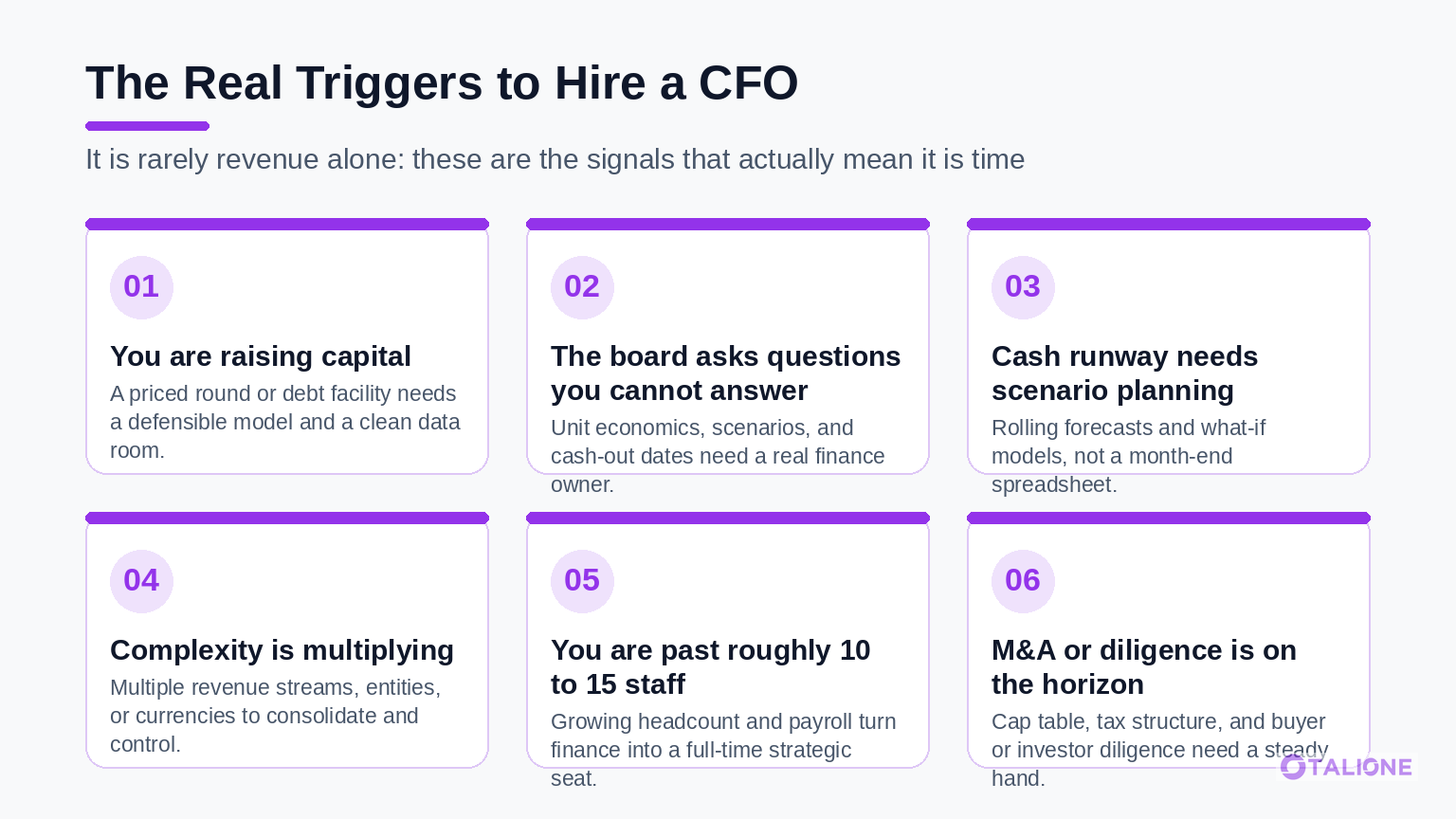
The real triggers are events that change the kind of finance work you need, not just the volume. Watch for these:
- You are approaching a raise or a debt facility. Priced rounds and lending both demand a defensible model, clean historicals, and a data room that survives diligence. This is the single most common reason a first CFO gets hired, and hiring reactively during the raise is the worst time to do it.
- The board is asking questions you cannot answer. When directors want unit economics, scenario plans, or a credible cash-out date and the response is a scramble, the organisation has outgrown its finance function.
- Cash runway needs real scenario planning. Rolling forecasts, hiring gates tied to revenue, and what-if models are CFO work, not something a month-end close produces.
- Complexity is multiplying. Multiple revenue streams, entities, currencies, or a move into recurring revenue all raise the cost of getting finance wrong.
- M&A or serious diligence is on the horizon. Acquiring, being acquired, or restructuring the cap table needs someone who has sat on the other side of a diligence table.
If two or more of these are true, you are past the debate. The question is no longer whether, but which model and how fast, which is closely tied to how long an executive search actually takes in Canada.
A CFO is not the reward for hitting a revenue number. It is the answer to questions your current team can no longer close.
What readiness signals tell you the seat is full-time?
Triggers tell you the type of work has changed. Readiness signals tell you there is now enough of it to justify a full-time, senior, and expensive hire. Look for a cluster, not a single line item:
- Scale of the team. Somewhere past roughly ten to fifteen employees, payroll, benefits, and people costs become the largest and most sensitive line on the page, and they need an owner.
- Finance is a bottleneck. Decisions wait on numbers that are late, contested, or built ad hoc each time. When the founder is the reporting layer, growth is capped by the founder's spreadsheet time.
- External scrutiny is rising. Investors, lenders, auditors, or a new board are all asking for a level of rigour your current setup delivers only with heroics.
- The finance calendar is now continuous. Not just a monthly close, but ongoing forecasting, covenant tracking, and capital decisions that never really stop.
If those signals are present but thin, that is precisely the case for a bridge rather than a permanent full-time hire, which we come to below.
Controller, VP Finance, or CFO: which role do you need?
Many first-time finance hires go wrong because the title and the need do not match. Companies hire a CFO to do controller work, or expect a controller to think like a CFO. These are three different jobs with three different centres of gravity.
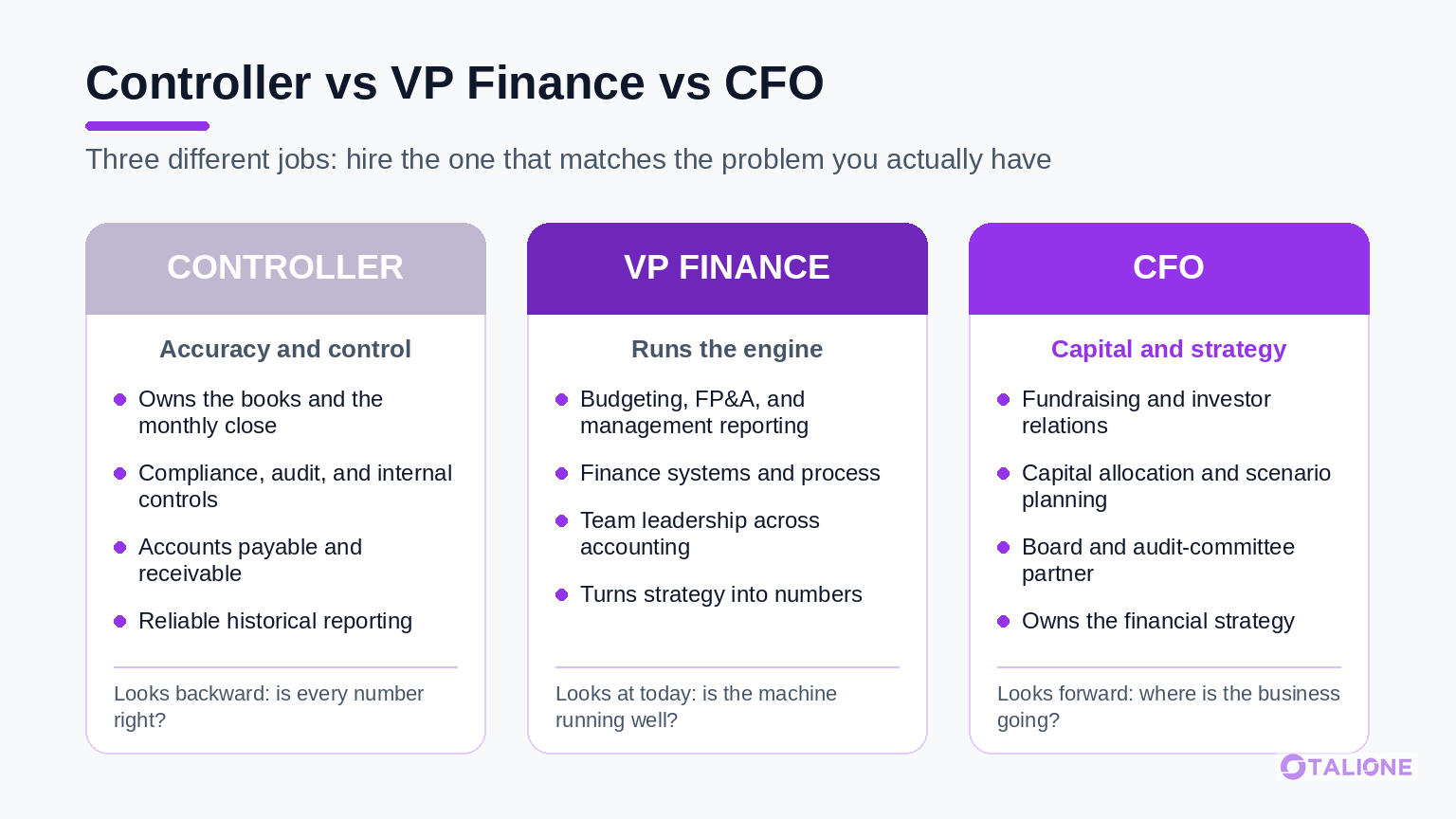
A controller looks backward and guarantees accuracy: the books, the close, compliance, and controls. A VP Finance looks at today and runs the engine: budgeting, FP&A, systems, and the finance team. A CFO looks forward and owns capital and strategy: fundraising, investor relations, capital allocation, and the board relationship. A strong CFO can cover the layers below, but paying CFO compensation for someone who spends the week reconciling accounts is an expensive mismatch, and asking a controller to lead a raise is a setup for failure.
The practical rule: name the two or three problems you actually need solved in the next year, then hire the level that owns those problems. If the problems are accuracy and compliance, you need a controller. If they are planning and process, a VP Finance. If they are capital, strategy, and the board, you need a CFO. For a wider view of how senior roles map to needs, see our guide to choosing between fractional, interim, and full-time leadership.
Should you bridge with a fractional CFO first?
Often, yes. A fractional CFO is an experienced finance executive working with you part-time, usually a day or two a week, for a defined problem or period. For many Canadian companies it is the smartest first move, and interest in fractional finance leadership has grown as founders look for senior expertise without a full-time commitment.
A fractional CFO does three useful things at once. First, it proves the need: you find out how much genuine CFO-level work exists before you commit to a full-time salary and equity. Second, it delivers immediately on the pressing item, whether that is getting a model investor-ready or building a forecast, without waiting out a full search. Third, and most underrated, a good fractional CFO helps write the permanent brief. Having done the work inside your business, they can tell you exactly what the full-time hire needs to own, which turns a vague job description into a scoped mandate.
The bridge is not always right. If you are actively raising a large round, if the finance function is already clearly full-time, or if you need a leader fully accountable and present, go straight to the permanent hire. But when the readiness signals are real yet still thin, a fractional bridge is the lower-risk path to the right permanent CFO. Weigh it against the full cost of an executive search in Canada when you decide.
What should you screen for in a first CFO?
Screen a first CFO for the work ahead, not the accounting behind. A first CFO in a growth company lives or dies on a few capabilities:
- Fundraising and capital. Have they actually run a raise or a financing, sat in diligence, and negotiated terms, or only reported to someone who did?
- Defensible models. Can they build a driver-based model a sophisticated investor will trust, and defend the assumptions under pressure?
- Data room and diligence. Do they know how to prepare a company to be examined, and to close a financing or a deal without surprises?
- Stage fit. A CFO who scaled a large public company may struggle in a scrappy fifteen-person business, and the reverse is also true. Match the person to the stage in front of you, not a famous logo.
- Board and communication. A CFO is a translator between the business and its capital providers. Clarity with a board is as important as technical depth.
Reference and interview for these directly. The same disciplined, forward-looking hiring that works for any senior seat applies here, as covered in our principles for hiring senior talent in Canada.
Not sure whether it is a CFO you need, or a bridge first?
Talione runs confidential, success-based executive searches across Canada with zero upfront cost. We help you scope the right finance seat before you open the search.
Start a search conversationWhat does the wrong or late CFO hire cost you?
The cost of getting this wrong is rarely a line on the budget. It shows up as a raise that closes slower or on worse terms, a quarter of decisions made on shaky numbers, or a board that loses confidence in the finance story. A late CFO hire means the founder is still the reporting layer during the exact moment the company most needs to move fast. A wrong CFO hire, someone senior on paper but mismatched to the stage or the mandate, can be even more costly, because unwinding a C-suite mistake takes months and a search you now have to run under pressure.
This is why timing deserves to be treated as a strategic decision, planned a couple of quarters ahead, rather than a reaction to a crisis. The founders who get it right decide the trigger, scope the mandate, and start the search before the raise or the board forces the issue. It mirrors the discipline behind knowing when to hire your first VP: the trigger is capability and complexity, not a number on a dashboard.
Frequently asked questions
At what stage or revenue should a company hire a CFO?
There is no universal number. Many Canadian companies bring on a first CFO somewhere in the scaling phase, often around or after a significant raise, but complexity and capital needs matter far more than a revenue line. A simple business can wait; a complex or capital-hungry one should move earlier.
What is the difference between a controller and a CFO?
A controller owns accuracy: the books, the close, compliance, and controls, looking backward. A CFO owns capital and strategy: fundraising, planning, and the board relationship, looking forward. They are complementary, not interchangeable.
Is a fractional CFO worth it?
For many growth-stage companies, yes. A fractional CFO gives you senior expertise part-time, proves how much CFO-level work you truly have, handles the pressing item, and helps write the brief for the eventual full-time hire, all at a fraction of a full-time cost.
Should I hire a CFO before or during a fundraise?
Before, if you can. Hiring during a raise means the person is learning your business at the worst possible moment. If a round is imminent and you have no finance leadership, a fractional or interim CFO can bridge you through the raise while you run a proper permanent search.
How long does it take to hire a CFO in Canada?
A senior finance search typically runs a few months from mandate to signed offer, longer once notice periods are factored in. That lead time is exactly why the decision should be made ahead of the trigger, not during it.
Can Talione help scope the role before we search?
Yes. We help you decide whether you need a controller, a VP Finance, a fractional bridge, or a full-time CFO, then run a confidential, success-based search with zero upfront cost.
Hiring senior talent in Canada?
Talione helps companies hire 4× faster with zero upfront costs. Let's find your next great hire.
Hire TalentRelated Posts
How to Stop a Counteroffer From Losing Your Executive Hire
A counteroffer looks like a money problem but is really a process problem. Here is the playbook to protect an executive hire from the first interview to the first day.
Fractional, Interim, or Full-Time? Choosing the Right Executive Leadership Model
Fractional, interim, or full-time executive? Compare cost, timeline, and fit, and learn how to choose the right leadership model for your senior gap.
Executive Reference Checks: The Questions That Actually Predict Success
Reference checks are where most senior hires are quietly saved or lost. Who to call, the questions that predict success, and the red flags to chase before you make the offer.