
5 Principles for Hiring Senior Talent in Canada
Senior hiring is high-stakes and slow by default. Five principles that consistently separate the hires that stick from the ones that do not.

Hiring a senior leader is one of the highest-stakes decisions a company makes, and one of the slowest. In Canada's tightest talent markets, the average executive search drags on for months while the cost of an empty seat quietly compounds. At Talione, we built our practice around a simple conviction: great senior hiring should be faster, more transparent, and carry zero upfront risk for the companies we serve.
This is the first post on the Talione blog. Here you'll find practical guidance on hiring senior talent in Canada, what we're seeing in the market, and the lessons we draw from the searches we run every week. To kick things off, here are five principles that consistently separate the hires that stick from the ones that don't.
The short version
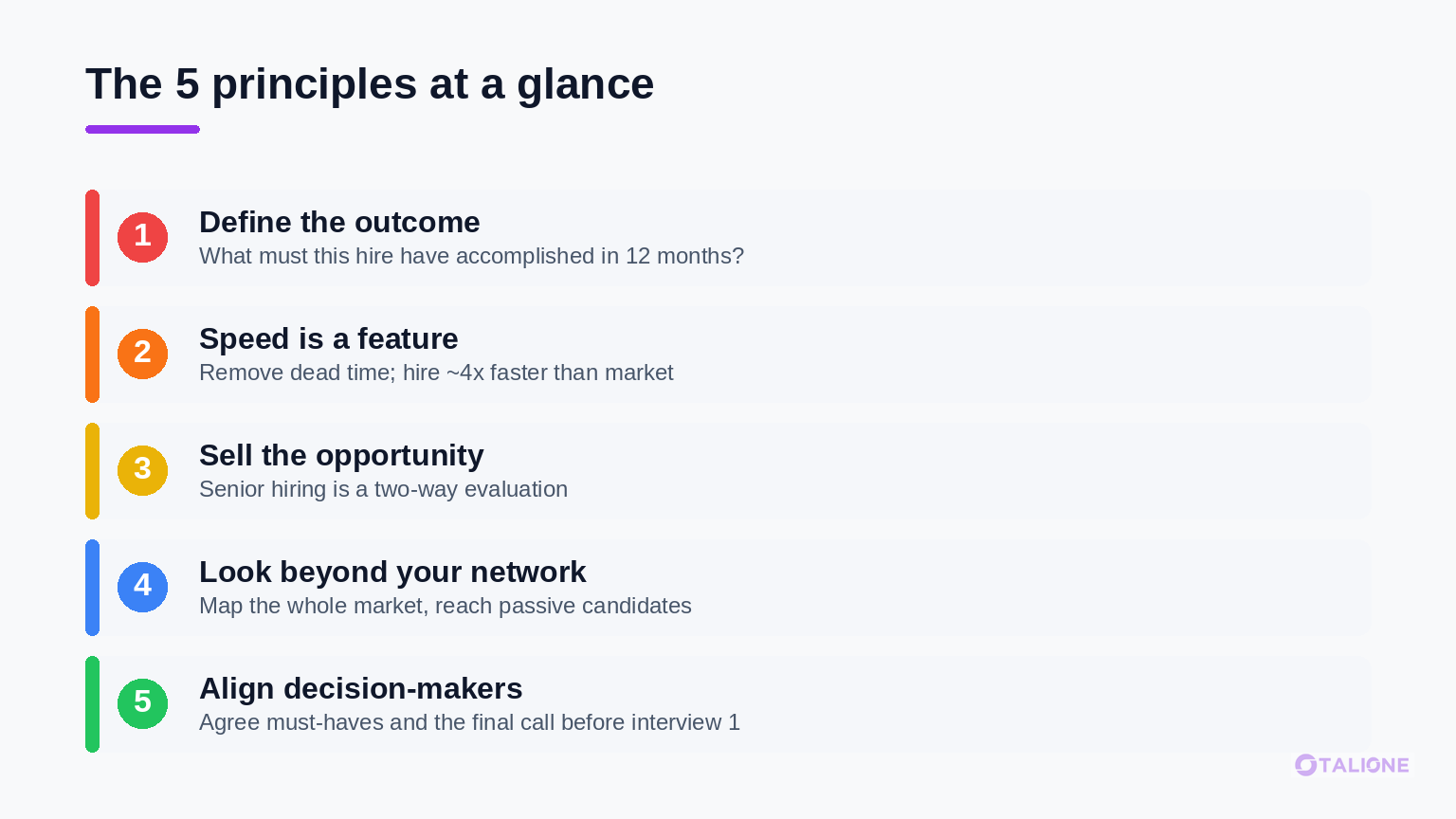
Senior hiring is high-stakes and slow by default. Five principles consistently separate hires that stick from ones that do not: define the 12-month outcome, treat speed as a feature, sell the role as hard as you screen for it, look beyond your network, and align decision-makers before interview one.
- Start from what success looks like in 12 months, not a job description.
- Remove dead time between stages; the best candidates do not wait.
- Every interaction is part of the pitch, not just an evaluation.
- Go wider than referrals to reach passive senior talent.
- Get everyone with a veto aligned before the first interview.
On this page
1. Define the outcome, not just the job title
The strongest searches start with a sharp definition of what success looks like 12 months in, not a recycled job description. Before we open a search, we push hiring teams to answer one question: what must this person have accomplished a year from now for everyone to agree the hire was a win? That single answer reshapes the scorecard, the outreach, and how candidates are assessed, and it filters out impressive-on-paper profiles who would never have moved the needle on what actually matters.
2. Speed is a feature, not a shortcut
Top candidates are rarely on the market for long, and the best ones are usually employed and not actively looking. A drawn-out process is the single most common reason companies lose them. Moving quickly isn't about cutting corners on diligence; it's about removing dead time between stages, aligning decision-makers before the search begins, and giving candidates a clear, respectful timeline. Companies that work with Talione typically hire roughly four times faster than the market average, not because they assess less, but because they waste less.
3. Sell the opportunity as hard as you screen for it
Senior hiring is a two-way evaluation. The most sought-after leaders are weighing your role against their current seat and other approaches. The companies that win treat every interaction as part of the pitch: a crisp story about the mission, an honest picture of the challenges, and a process that respects the candidate's time. If your interview loop feels like an interrogation, your best prospects will quietly opt out.
4. Look beyond your immediate network
Referrals are valuable, but they tend to reproduce the team you already have. Genuinely strong senior searches go wider, into adjacent industries, underrepresented talent pools, and passive candidates who would never respond to a job posting. This is where a dedicated recruitment partner earns its keep: mapping an entire market, reaching people who aren't looking, and surfacing candidates a job board never will.
5. Align decision-makers before the first interview
Nothing kills a search faster than discovering, three candidates in, that the founder and the board wanted different things all along. Get the people who hold a veto in the same room early. Agree on the must-haves, the deal-breakers, and who makes the final call. The hour spent aligning up front saves weeks of churn and protects you from losing a great candidate to indecision.
Why we do it with zero upfront cost
We put our model where our convictions are. Talione works on a success basis: companies pay when we deliver the right hire, not before. It keeps our incentives perfectly aligned with yours, and it means the risk of a search sits with us, not with you. That structure only works if we're genuinely good at what we do, which is exactly the standard we want to be held to.
Frequently asked questions
How long should an executive search take in Canada?
A focused senior search typically runs six to twelve weeks. Most delays are self-inflicted: misaligned decision-makers, slow feedback, and dead time between stages rather than a shortage of candidates.
What does zero upfront cost actually mean?
Talione works on a success basis. You pay when the right hire is placed, not before, so the risk of the search sits with us and our incentives stay aligned with yours.
Why look beyond referrals for senior roles?
Referrals reproduce the team you already have. The strongest senior candidates are usually employed and not looking, so reaching them takes deliberate market mapping, not a job posting.
Who should be aligned before the first interview?
Everyone who holds a veto: the hiring manager, the founder or CEO, and any board members involved. Agree the must-haves, the deal-breakers, and who makes the final call up front.
Whether you're scaling a leadership team or replacing a critical seat, the fundamentals above will serve you well. And when you'd rather have a partner run the search end to end, we're here to help.
Welcome to the Talione blog. More to come.
Hiring senior talent in Canada?
Talione helps companies hire 4× faster with zero upfront costs. Let's find your next great hire.
Hire TalentRelated Posts
Retained vs Contingent Executive Search in Canada: Which Model Should You Use?
A plain-English, Canada-specific guide to retained vs contingent executive search: how each model works, what it costs, when to use which, and how to vet a search partner.