
Executive Compensation in Canada: 2026 Benchmarks and How to Structure a Competitive Offer
Executive compensation in Canada in 2026 is best read as total compensation, not base salary. Directional benchmarks for director, VP and C-suite roles, and how to structure an offer that closes.

Most executive searches in Canada are won or lost at the offer stage, not the sourcing stage. You can run a flawless process, build a strong shortlist, and still watch your first choice decline because the number arrived late, landed low, or was framed as a base salary when the candidate was thinking in total compensation. This guide sets out directional 2026 benchmarks for senior roles across Canada and shows how to structure an offer that a director or VP level candidate actually signs.
The short answer. Executive compensation in Canada in 2026 is best read as total compensation, not base salary. For a director or VP hire, base typically runs from about $130,000 to $300,000, and base makes up only a third to a half of the package once bonus, equity or long term incentive, and signing are added. The number that closes a senior candidate is the one that is benchmarked to current data, framed as a total, and approved before you extend.
- Directional 2026 base: director $130,000 to $200,000, VP $150,000 to $300,000, CFO and C-suite $200,000 to $420,000.
- Base is roughly 30 to 50 percent of total compensation for senior roles. Bonus and long term incentive carry the rest.
- Benchmark to current market data, not to your last hire or a gut number.
- A slow or lowball offer is the most common way a strong finalist walks.
- Pre-approve a compensation band before the search, so you can move in days, not weeks.
On this page
- What is the typical executive compensation range in Canada in 2026?
- Why is base salary only a third of the story?
- How do you structure an executive offer that closes?
- How much does executive pay vary by region and industry in Canada?
- How does a lowball or slow offer lose the candidate?
- What should you have ready before you extend an offer?
- Frequently asked questions about executive compensation in Canada
What is the typical executive compensation range in Canada in 2026?
Direct answer: for senior hires in Canada in 2026, base salary alone runs roughly from $130,000 for a functional director to well over $400,000 for a chief financial officer at a larger company, and base is only one part of the package. Treat every figure here as directional. Real ranges move with company size, sector, ownership, and how business critical the role is.
As a working guide for the mid market roles we place most often at Talione:
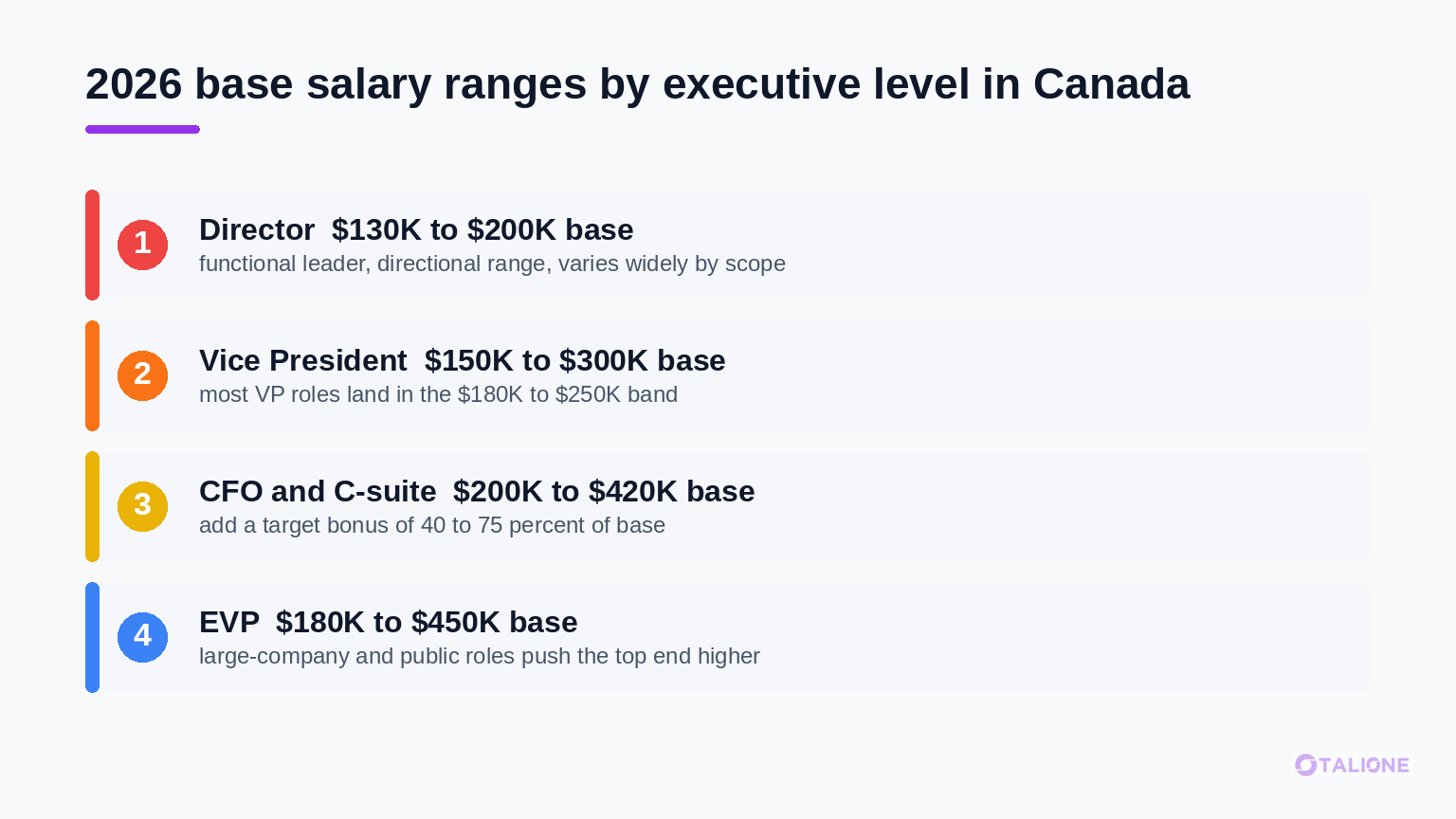
- Director: about $130,000 to $200,000 base, plus a target bonus in the range of 15 to 30 percent.
- Vice President: about $150,000 to $300,000 base, with most VP roles clustering in the $180,000 to $250,000 band before bonus and equity.
- CFO and other C-suite: about $200,000 to $420,000 base, with a target bonus often set at 40 to 75 percent of base.
- Executive Vice President: about $180,000 to $450,000 base, with the top of the range driven by large and public companies.
These are national reference points. A VP of Engineering at a funded Toronto software company and a VP of Operations at a regional manufacturer can both be paid fairly and still sit a hundred thousand dollars apart. That is why the range matters less than the benchmark you build for your specific role, market, and stage. For the full picture of what a search itself costs, see our companion guide on how much executive search costs in Canada.
Why is base salary only a third of the story?
Direct answer: for senior roles, base salary usually represents only 30 to 50 percent of total compensation. The rest is carried by the annual bonus, long term incentives or equity, and one time elements such as a signing bonus. Read an offer as a single total number and you will benchmark and negotiate far more accurately.
Four components sit on top of base, and each one can be the piece that decides the offer:
- Annual bonus, or short term incentive. At the executive level the target bonus is commonly 40 to 75 percent of base, paid on a mix of company and individual performance. Actual payouts swing widely with results, so present both the target and how it is measured.
- Long term incentive, or equity. At larger and public companies this is often the single biggest component, frequently 20 to 40 percent of the package and higher for the most senior roles. Common vehicles are performance share units, restricted share units, and stock options, usually vesting over three to four years. The directional trend in 2026 is toward larger long term grants as Canadian employers compete for talent on a North American basis.
- Signing bonus. A one time payment used to offset a bonus or unvested equity the candidate forfeits by leaving their current employer.
- Severance and change of control terms. Senior candidates read these closely. A clear severance provision is often what tips a comfortable executive into leaving a stable seat.
For a senior leader, the base salary is only the floor of the conversation. The bonus, the equity, and the exit terms are where the offer is actually won.
How do you structure an executive offer that closes?
Direct answer: build the offer around three moves. Benchmark to current market data, present it as total compensation rather than a base number, and use non-cash levers to close the gap when your cash band is fixed.
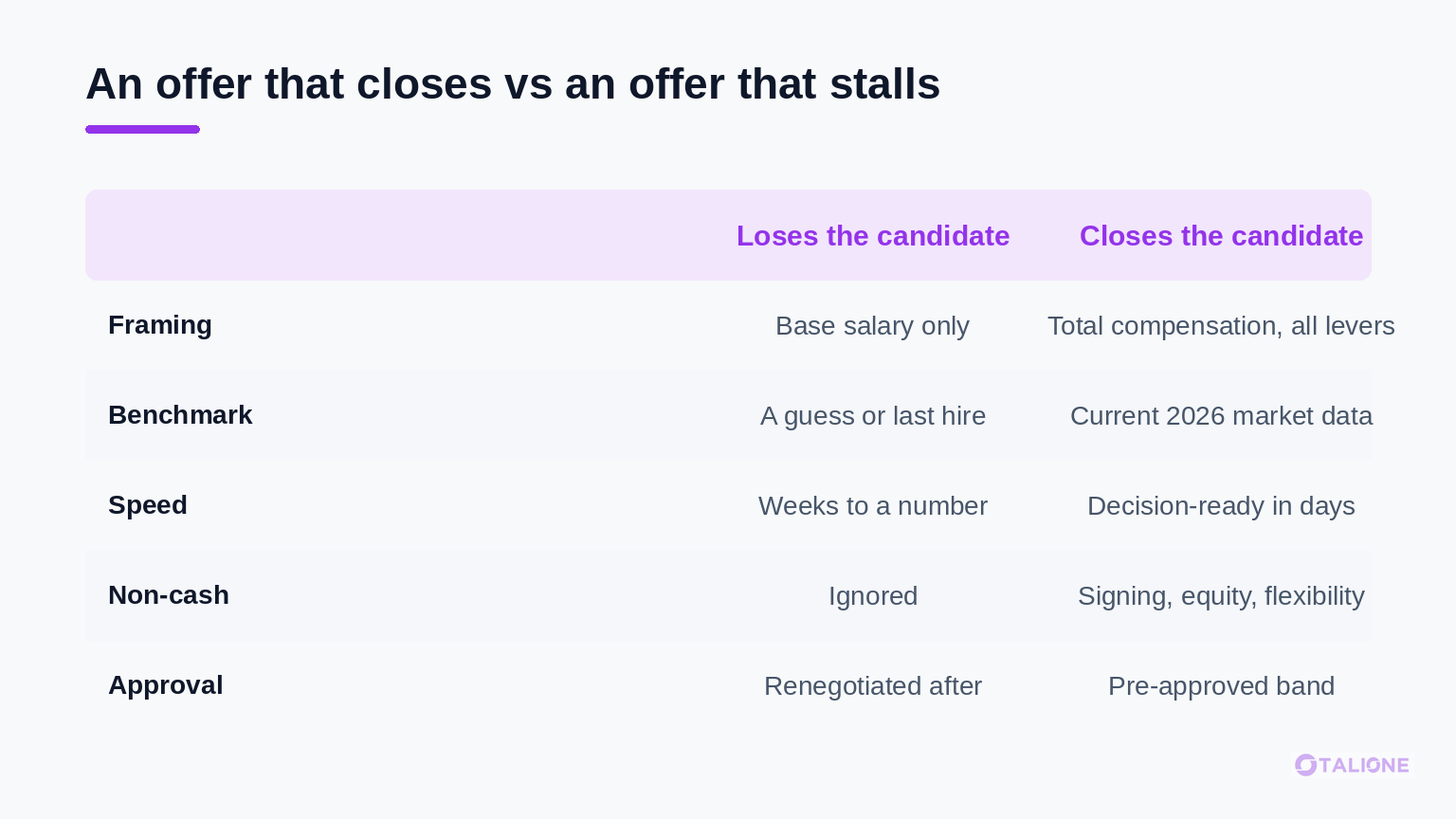
- Benchmark to now. Pull current 2026 data for the exact title, sector, and region, not last year and not your last hire. Bands have drifted upward as Canadian companies compete across North America, and a stale benchmark quietly puts you below market.
- Frame the total. Present base, target bonus, equity value, and any signing amount as one annual figure with a clear multi year view. A $190,000 base can look thin next to a competitor until the candidate sees the full package beside it.
- Use non-cash levers. When the cash band is capped, title, scope, reporting line, board exposure, hybrid flexibility, extra vacation, and an accelerated first review can all move a decision. These often cost little and matter a great deal to senior people.
Building a director or VP offer and unsure your number will land?
Talk to Talione about your search
How much does executive pay vary by region and industry in Canada?
Direct answer: quite a lot. Toronto and Vancouver typically sit at the top of the national range, while sectors such as financial services, technology, energy, and mining pay a premium for scarce senior talent. A single national average can mislead you by a wide margin.
Geography is the first variable. Major metros carry a cost of living and a competitive premium that a smaller regional market does not, so the same title can differ by tens of thousands of dollars between Toronto and a mid sized city. Industry is the second. A VP in a high margin technology or finance business is usually benchmarked well above the same title in a traditional or non profit setting.
Company stage and ownership shift the mix as much as the total. A funded startup may keep cash modest and lean heavily on equity, while a mature private company often pays more cash and less equity. Public companies bring formal long term incentive plans that can dominate the package. Read your benchmark against companies that look like yours, not against a headline national number.
How does a lowball or slow offer lose the candidate?
Direct answer: the two most common ways a strong finalist walks are an offer that lands below market and an offer that arrives too slowly. Both signal the same thing to a senior candidate, that the role is not a genuine priority.
Remember who you are hiring. A strong executive candidate is usually employed, performing well, and not desperate to move. The moment your process slows, a competing offer or a counteroffer from the current employer fills the gap. Every extra week erodes the momentum you built, and a number that lands low invites the incumbent employer to counter and win. Speed and a credible first number are not niceties, they are how you protect the search you already paid for. For where offers usually stall, see our guide on the executive search timeline in Canada.
What should you have ready before you extend an offer?
Direct answer: before you make the call, have your benchmark, your approved band, and your full package details settled, so you can present a complete and credible number the same day you decide.
- A current 2026 benchmark for the exact title, sector, and region.
- A pre-approved compensation band, signed off by whoever controls budget, before the finalist stage.
- The full package written out: base, target bonus and how it is measured, equity or long term incentive detail with vesting, and a signing bonus if you will use one.
- Clear severance and, where relevant, change of control terms.
- The non-cash levers you are willing to use if the cash band is reached.
- A named decision maker who can say yes within a day.
This discipline is part of a broader approach we set out in five principles for hiring senior talent in Canada. If you are weighing how to engage a search partner while you build the offer, compare retained versus contingent executive search.
Frequently asked questions about executive compensation in Canada
What is a typical base salary for a VP in Canada in 2026?
Directionally, most VP roles fall between $150,000 and $300,000 base, with a large share in the $180,000 to $250,000 band. Add a target bonus of roughly 20 to 40 percent and, at many companies, an equity or long term incentive component on top.
What percentage of executive pay is bonus and equity?
For senior roles, base is often only 30 to 50 percent of total compensation. The annual bonus and long term incentive carry the balance, and at larger or public companies the long term incentive can be the single largest piece.
Should you include a signing bonus in an executive offer?
Often yes. A signing bonus is the cleanest way to offset a bonus payout or unvested equity a candidate forfeits by leaving. It closes a real gap without permanently raising your base.
How do you avoid losing a candidate to a counteroffer?
Benchmark accurately so your first number is competitive, move quickly so momentum does not fade, and frame the role around scope and growth, not only cash. A lowball or a slow process is what usually opens the door to a counteroffer.
How much does executive pay vary across Canada?
Significantly. Toronto and Vancouver usually sit at the high end, and sectors such as finance, technology, and energy pay a premium. A national average can be off by a wide margin for your specific market.
Hiring senior talent in Canada?
Talione helps companies hire 4× faster with zero upfront costs. Let's find your next great hire.
Hire Talent