
The First 90 Days: An Executive Onboarding Plan That Prevents Failed Senior Hires
A 30-60-90 onboarding plan that keeps a senior hire from becoming an expensive miss, and what the hiring leader owns.

Short answer: A strong executive hire succeeds or fails in the first 90 days, and rarely because of talent. Close to half of new executives underperform or leave within 18 months, most often because onboarding was left to chance. A deliberate 30-60-90 plan, owned jointly by the new leader and the hiring executive, is what turns an expensive search into a lasting hire.
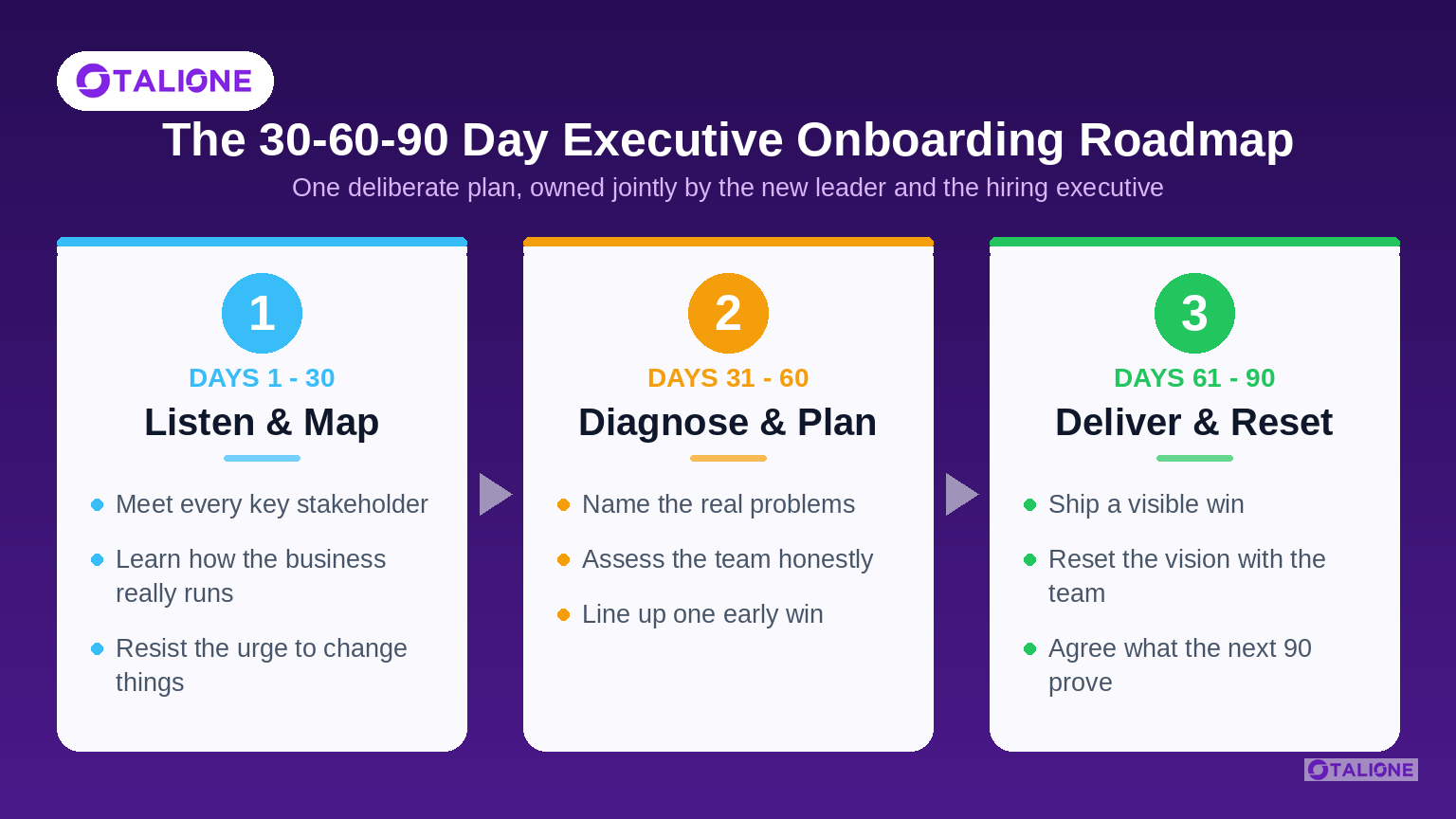
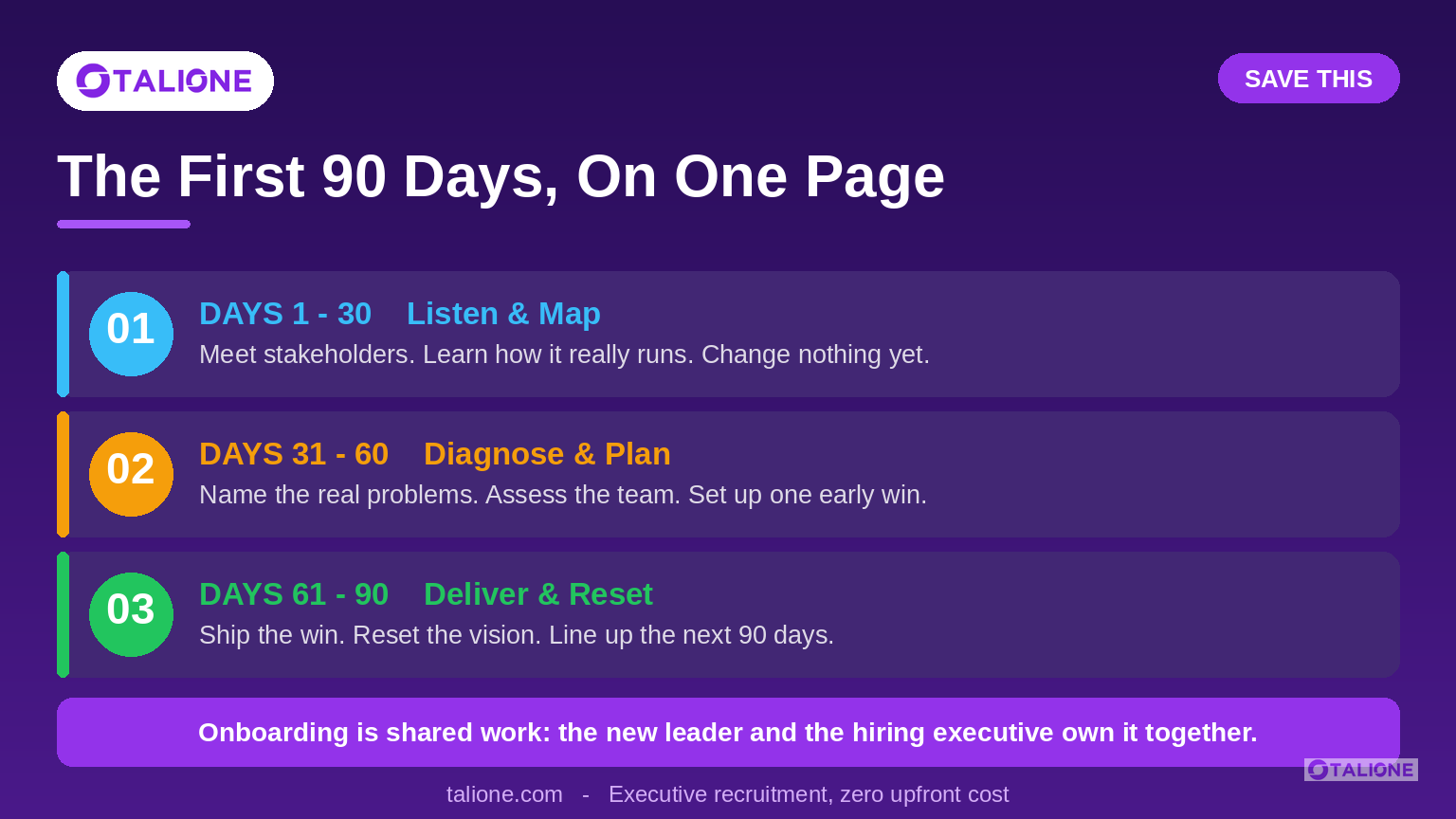
- Days 1 to 30 are for listening, mapping stakeholders and learning how the business truly runs, not for sweeping change.
- Days 31 to 60 are for diagnosis: name the real problems, assess the team and line up early wins.
- Days 61 to 90 are for a visible win and a reset of the vision with the team behind it.
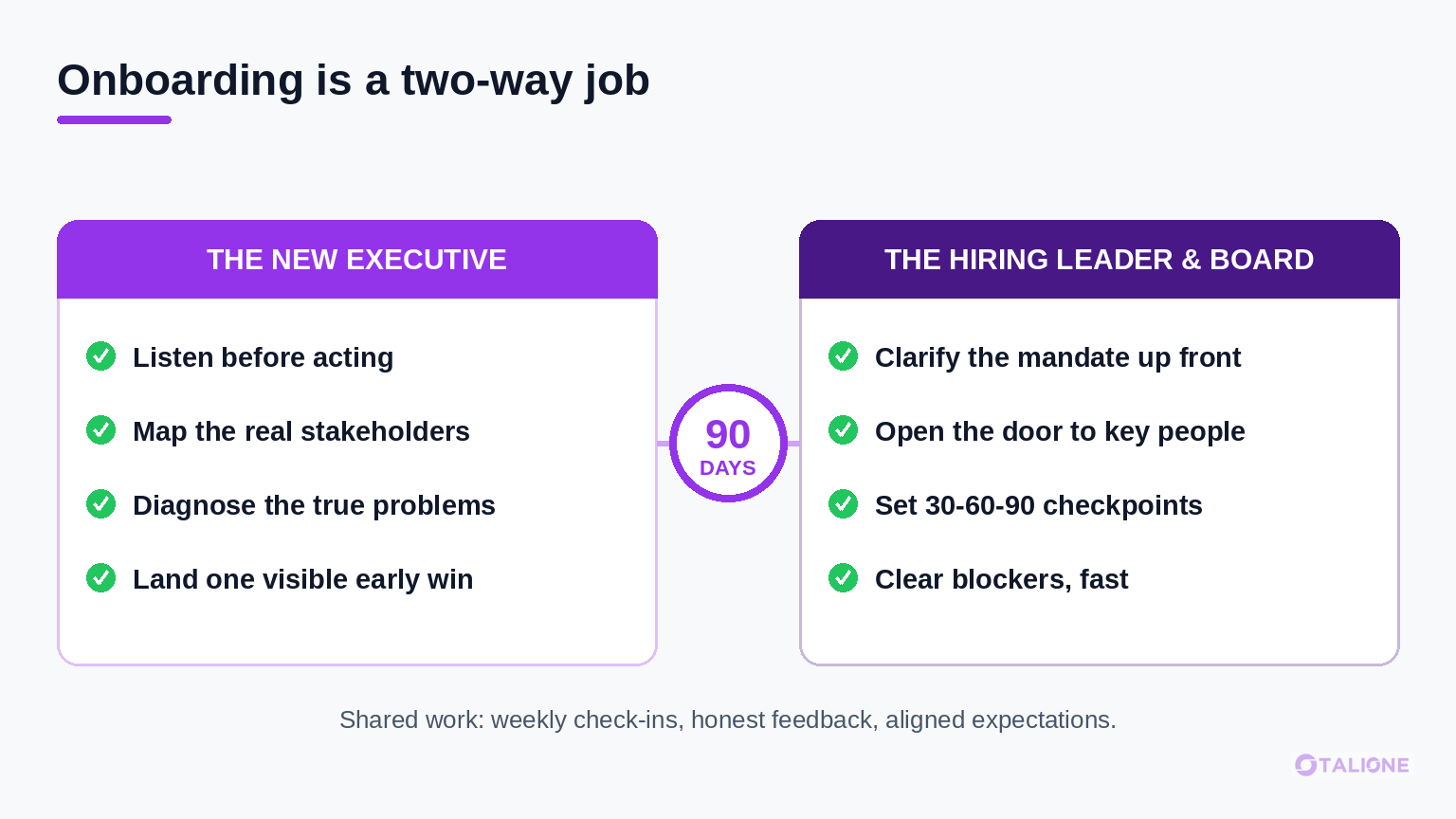
- Onboarding is a two-way job. The hiring leader and board carry as much of it as the new executive.
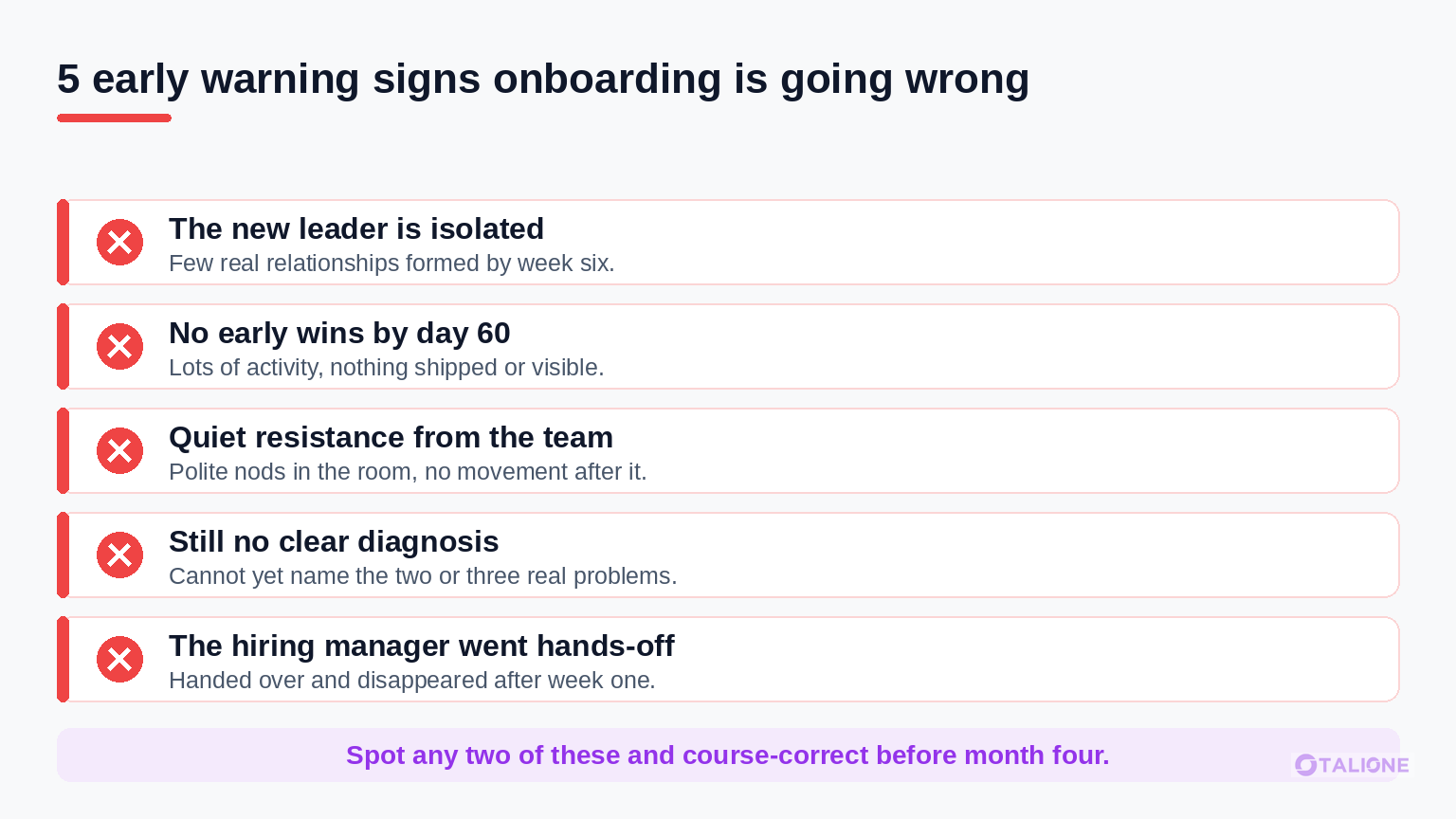
- Watch for early-warning signs (isolation, no wins, quiet resistance) and course-correct before month four.
On this page
- Why do strong executives fail in the first 90 days?
- What does a failed executive hire actually cost?
- What should the new executive do in the first 30 days?
- What happens in days 31 to 60?
- What does the 61 to 90 day stretch look like?
- What is the hiring leader's role in onboarding?
- How do you spot onboarding going wrong and course-correct?
- Frequently asked questions
You ran a careful search. You benchmarked the compensation, managed the close and signed a director or VP you were genuinely excited about. Then the real risk begins. The most expensive mistake in executive hiring is not choosing the wrong person. It is choosing the right person and then leaving their first 90 days to chance.
This is the onboarding plan we walk our clients through once an offer is signed. It is written for the two people who own the outcome together: the new executive who has to earn the room, and the hiring leader or board who has to set them up to.
Why do strong executives fail in the first 90 days?
Strong executives fail early because the transition, not the talent, defeats them. Someone who was excellent in their last role walks into a new company with no context, no relationships and no credibility, and often tries to prove their worth too fast. The classic failure is a leader who arrives with answers before they understand the questions.
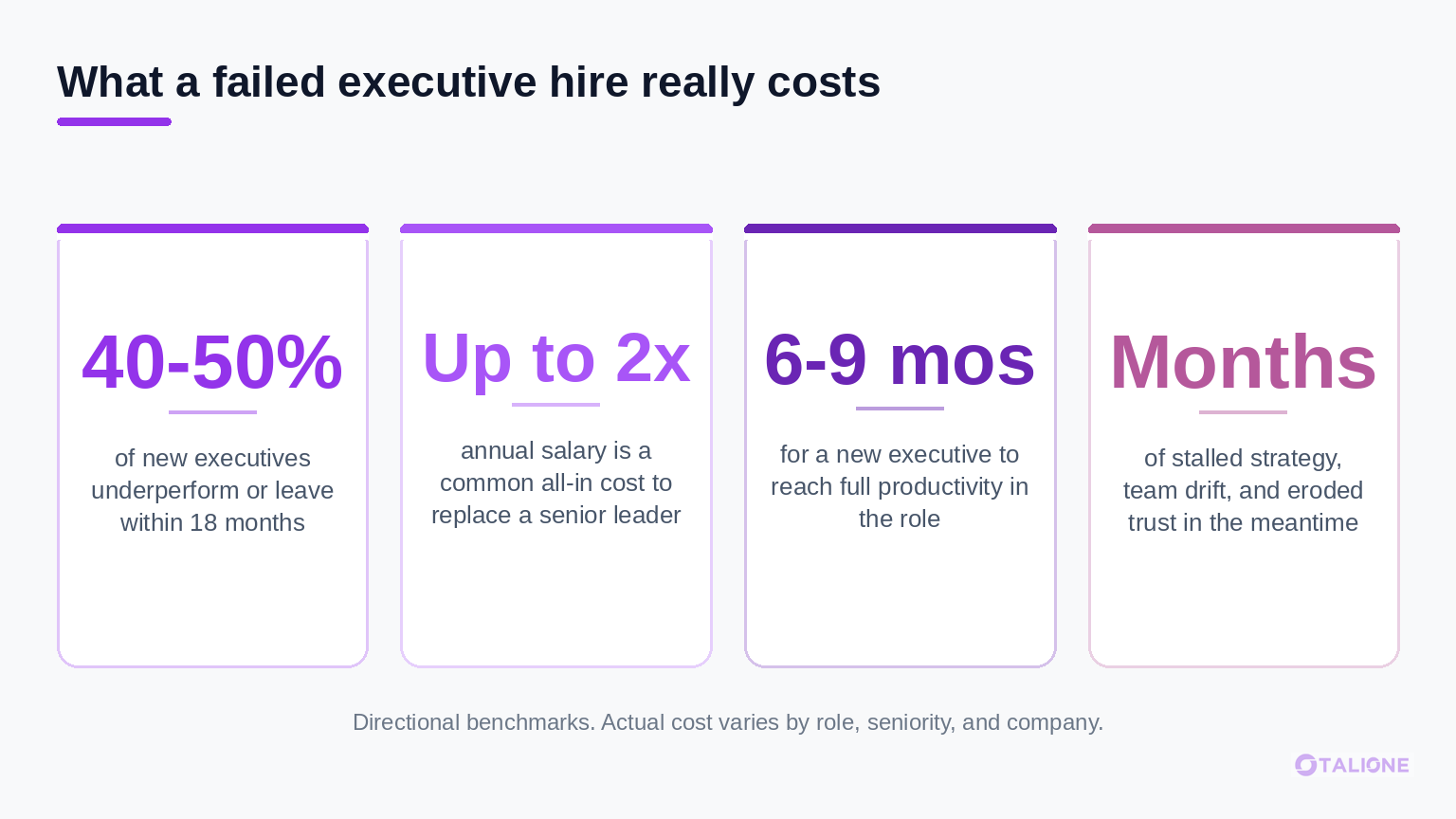
The scale of the problem is well documented. Directional research from McKinsey and others puts the share of new executives who underperform or leave within 18 months somewhere between 40 and 50 percent, and the most common cause is not competence. It is weak integration: misread culture, misaligned expectations and no structured plan for the first three months.
The good news hidden in that number: if most failures come from onboarding rather than hiring, most are preventable. The first 90 days are the highest-leverage window you will ever have with a senior hire.
What does a failed executive hire actually cost?
A failed executive hire costs far more than one salary. When a director or VP leaves inside 18 months, you absorb the original search, the compensation paid, the cost of a second search, and the months the seat sits empty or half-filled. Then come the costs that never show up on an invoice: stalled initiatives, a team that has now watched two leaders come and go, and customers or board members who quietly lose confidence.
Most estimates put the fully loaded cost of a failed senior hire well above the person's annual compensation once the ripple effects are counted. For a sense of the numbers you are protecting, see our guides on what executive search costs in Canada and how executive compensation is structured. The point is simple: onboarding is not an HR nicety. It is the cheapest insurance you can buy on the most expensive hire you will make this year.
You did not spend three months hiring a leader so they could spend the next three months guessing. The plan is the point.
What should the new executive do in the first 30 days?
In the first 30 days, the new executive's job is to learn, not to lead visibly. This is the listening month. The goal is to build an accurate map of the business, the people and the culture before making a single meaningful decision.
A strong first month usually covers four things:
- Listen widely. Structured one-on-ones with direct reports, peers, the hiring leader and a few key people below and outside the team. Ask what is working, what is broken and what they hope changes. Then mostly listen.
- Map the stakeholders. Who holds influence, who owns which outcomes, and where the informal power sits. Titles rarely tell the whole story.
- Learn the culture. How decisions actually get made, how conflict is handled, what gets rewarded. Violating an unwritten rule in week two costs credibility you cannot easily rebuild.
- Set expectations both ways. Agree with the hiring leader on what success looks like at 30, 60 and 90 days, and be transparent with the team about how you like to work.
The discipline of month one is resisting the urge to act. Early sweeping change signals insecurity, not strength. The leaders who last are the ones who earn the right to change things by first proving they understand them.
What happens in days 31 to 60?
Days 31 to 60 are the diagnosis phase. With a month of listening behind them, the new executive moves from gathering to shaping: naming the real problems, assessing the team honestly and choosing where to place early bets.
Three priorities define this stretch:
- Diagnose the real problems. Separate the noise from the two or three issues that actually move the business. A good brief, agreed before the search even began, makes this far faster. If the role was scoped around year-one outcomes, the priorities are already half written.
- Assess the team. Who are the keepers, who needs development, and where are the gaps. No dramatic moves yet, but the picture should be forming.
- Line up quick wins. Identify one or two early wins that are visible, achievable and genuinely useful, not cosmetic. These build the credibility that funds the harder changes ahead.
By day 60, the new leader should be able to sit down with the CEO or board and say, clearly, here is what I have found, here is where I am taking this, and here is what I need. If they cannot, the onboarding has stalled and it is time to look at why.
What does the 61 to 90 day stretch look like?
The 61 to 90 day stretch is where the new executive delivers. Listening and diagnosis now convert into a visible early win and a reset of the vision, with the team bought in rather than merely informed.
This phase has two jobs:
- Deliver a visible win. Execute on one of the quick wins identified in month two and let the organization see it land. This is the moment credibility becomes momentum.
- Reset the vision. Bring the team together around a clear, honest picture of where the function is going and why. After 60 days of listening, the leader has earned the room. The vision now lands as informed direction, not an outsider's opinion.
Ninety days is not the finish line. It is the moment the new executive stops being new and starts being accountable. A clean 90 days does not guarantee a great hire, but a messy one almost always predicts a struggling one.
Hiring a senior leader you cannot afford to lose in year one?
Talione runs confidential, success-based executive search across Canada, with zero upfront cost and a focus on hires that stick. Let us help you find the right leader and set them up to last.
What is the hiring leader's role in onboarding?
Onboarding is a two-way job, and the hiring leader owns half of it. The most common reason a promising executive stalls is not their effort. It is a manager or board that hired well and then disappeared, assuming a senior person needs no support.
The hiring leader's real job in the first 90 days is to remove friction and provide context:
- Front-load context. Share the history, the politics and the landmines the new leader cannot see. Do not let them step on a mine you could have flagged.
- Make the introductions. Personally connect them to the stakeholders who matter, and signal your visible support so the organization takes the new leader seriously.
- Align on the scorecard. Agree explicitly on what success looks like at 30, 60 and 90 days. Ambiguity here is where good hires quietly derail.
- Check in on a schedule. Weekly at first, then every two weeks. Make it a real conversation about obstacles, not a status update.
Boards play a role too, especially for C-suite hires. A leader stepping into a company still carrying a predecessor's shadow, or replacing someone the market has not been told about yet, needs air cover from the top. When the transition itself is sensitive, our guide to confidential executive search covers how to manage the discretion that a clean onboarding depends on.
How do you spot onboarding going wrong and course-correct?
You spot a struggling onboarding by watching for a small set of early-warning signs, and you course-correct by naming the problem directly rather than hoping it resolves itself. The mistake most companies make is waiting until month six, when the pattern is set and much harder to reverse.
The signals worth watching:
- Isolation. The new leader is not building relationships beyond their immediate team, or is quietly being worked around.
- No wins by day 60. Still gathering information with nothing to show and no clear point of view forming.
- Quiet resistance. The team nods in meetings but nothing changes, a sign trust has not been earned.
- Culture friction. Repeated small collisions with how the company actually operates.
- Silence from the top. The hiring leader has stopped checking in, so no one has an honest read on how it is going.
Course-correcting is rarely dramatic. It usually means the hiring leader restarting honest check-ins, giving direct feedback the new executive can act on, or re-clarifying priorities that drifted. Caught in month two or three, most wobbles are recoverable. Left until month six, many are not. A hire that was scoped and onboarded well is far easier to keep, which is why we treat both the search timeline and the brief as part of the same job. For the principles that sit underneath all of it, see our 5 principles for hiring senior talent in Canada.
Frequently asked questions
How long does executive onboarding really take?
The intensive window is the first 90 days, but full integration for a senior leader typically runs six to twelve months. The 30-60-90 plan front-loads the highest-risk period; beyond it, the leader is accountable rather than onboarding.
Should a new executive make changes in the first 30 days?
Rarely. The first month is for listening and mapping. Early sweeping change, before understanding the culture and the real problems, is one of the most reliable ways to lose credibility. Earn the right to change things first.
Who is responsible for executive onboarding, HR or the manager?
Primarily the hiring leader, with the new executive as an equal partner. HR can provide structure and logistics, but context, introductions and honest feedback have to come from the manager or board. Onboarding delegated entirely to HR usually underdelivers.
What is the single biggest onboarding mistake?
Assuming a senior hire needs no support. Companies invest heavily in the search, then go quiet the moment the person starts. The first 90 days need as much attention as the hire itself.
Can good onboarding save a questionable hire?
Sometimes, but it cannot fix a genuine mismatch. Onboarding protects a good hire and helps a borderline one find footing. It is not a substitute for scoping the role well and running a rigorous search in the first place.
An executive hire is only as good as the first 90 days that follow it. If you are about to make a senior hire you cannot afford to lose, or you want a search partner who cares whether the person is still thriving a year later, talk to Talione.
Hiring senior talent in Canada?
Talione helps companies hire 4× faster with zero upfront costs. Let's find your next great hire.
Hire TalentRelated Posts

When to Hire a CFO in Canada: Signs, Timing, and the Fractional Bridge
The real triggers to hire a CFO in Canada, how the role differs from a controller or VP Finance, when a fractional bridge makes sense, and what to screen for.
How to Stop a Counteroffer From Losing Your Executive Hire
A counteroffer looks like a money problem but is really a process problem. Here is the playbook to protect an executive hire from the first interview to the first day.
Fractional, Interim, or Full-Time? Choosing the Right Executive Leadership Model
Fractional, interim, or full-time executive? Compare cost, timeline, and fit, and learn how to choose the right leadership model for your senior gap.