
Fractional, Interim, or Full-Time? Choosing the Right Executive Leadership Model
Fractional, interim, or full-time executive? Compare cost, timeline, and fit, and learn how to choose the right leadership model for your senior gap.

Every leadership gap looks urgent, but not every gap needs the same answer. A founder losing a head of sales, a board watching a CFO retire, and a scale-up that has never had a real marketing leader are three different problems, and hiring a permanent executive is only one of three ways to solve them. The other two, fractional and interim leadership, are growing fast because they let you buy exactly the amount of senior help the situation calls for.
This guide breaks down all three models, when each one fits, what they cost, and how to decide, so you fill the gap without over-hiring or waiting too long.
The short answer
Fractional, interim, and full-time are three different ways to fill a senior leadership gap. Fractional gives you part-time expertise for a specific problem, interim is a full-time bridge while you search, and full-time is a permanent leader who owns the function. The right choice depends on the problem, the timeline, and how permanent the need really is.
- Fractional: a few days a month, three to twelve months, best for a defined problem or missing expertise.
- Interim: full-time but temporary, best for holding a seat that just went empty.
- Full-time: permanent, best when the function needs daily ownership and team building.
- Cost is not the whole story: match the model to the problem, not just the budget.
- They often sequence: fractional or interim can buy you time to hire the right permanent leader.
On this page
- What is the difference between fractional, interim, and full-time executives?
- When does a fractional executive make sense?
- When should you hire an interim executive?
- When is a full-time executive the right hire?
- How do the three models compare on cost and time to fill?
- How do you decide which model to use?
- Can these models sequence into one permanent hire?
- Frequently asked questions
What is the difference between fractional, interim, and full-time executives?
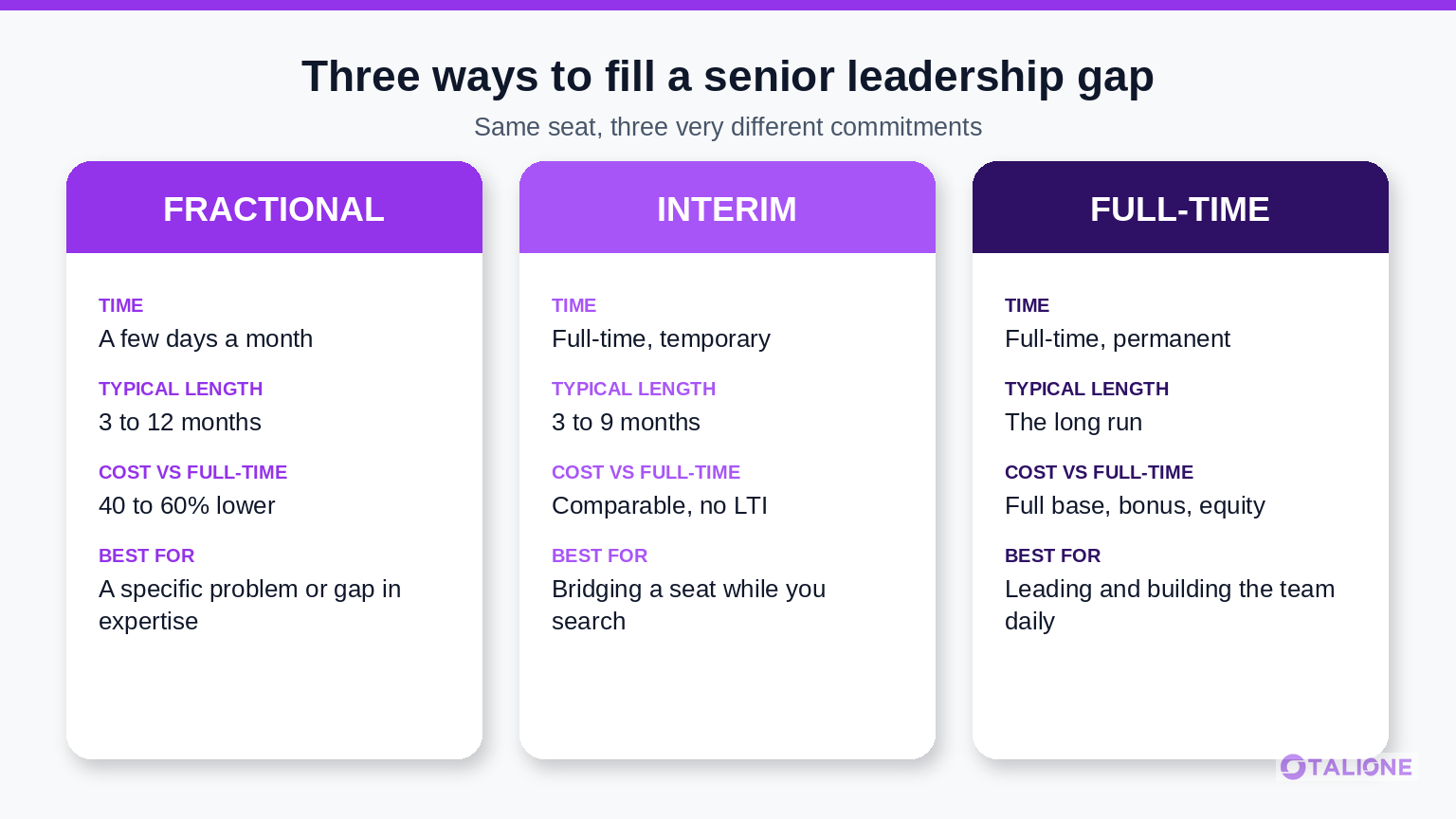
The difference comes down to how much time the leader gives you and how long the arrangement lasts. A fractional executive works part-time, a few days a month, usually across a fixed scope of work. An interim executive works full-time but temporarily, holding a seat until a permanent leader arrives. A full-time executive is a permanent hire who owns the function, builds the team, and stays for the long run.
Put simply, fractional is about depth of expertise without a full salary, interim is about coverage while you search, and full-time is about ownership over years. Each solves a real problem, and the trouble starts only when you pick one to save money rather than to match the need.
When does a fractional executive make sense?
A fractional executive makes sense when you have a specific problem that needs senior judgement but not a full-time leader. Common examples are a fractional CFO who sets up reporting and readies you for a raise, or a fractional CMO who builds the first real marketing engine. You get someone who has done the job at scale, for a fraction of the cost and commitment.
Signs a fractional hire is the right call:
- The work is a defined project or a recurring but part-time need, not a daily leadership role.
- You cannot yet justify or afford a full executive salary, but the gap in expertise is real.
- You need senior credibility with investors, a board, or a bank on a specific topic.
- You want to test what good looks like in a function before you commit to a permanent hire.
The limit shows up when the function starts to need daily presence and team leadership. A fractional leader can design the system, but someone has to run it every day. When you find yourself wishing they were in the building full-time, you have outgrown the model.
When should you hire an interim executive?
You hire an interim executive when a full-time seat has just gone empty and you cannot leave it empty while you search. A senior leader resigns, goes on leave, or is moved out, and the function still has to run: numbers close, teams get managed, decisions get made. An interim leader steps in full-time to keep momentum and stabilise the team while you run a proper search for the permanent hire.
Interim leadership also fits a defined transformation, such as steering a turnaround, integrating an acquisition, or standing up a function for the first time, where you want experienced hands for a set period rather than forever. Because interim leaders are hired to leave, the best of them are unusually focused on outcomes and handover, not on building an empire.
Cost is the easiest number to compare and the worst one to decide on. The real question is whether the problem is temporary or permanent.
When is a full-time executive the right hire?
A full-time executive is the right hire when the function needs permanent ownership, a leader who builds and grows the team, sets multi-year strategy, and carries the culture. This is the default for any role that is central to how the company runs and wins, and it is almost always the endgame even when you start with fractional or interim help.
Choose full-time when the answer to three questions is yes: Is this a permanent part of the business? Does it need daily leadership and team building, not just expertise? Will the person carry a long-term mandate that only makes sense if they stay? When you are there, the conversation shifts from filling a gap to running a real search, and that is where getting the brief and the process right pays off. Our guide to running the search in-house versus with a firm covers who should lead that hire.
How do the three models compare on cost and time to fill?
On cost, fractional is the cheapest by a wide margin because you pay for part-time work with no bonus or equity, often forty to sixty percent below a full-time equivalent on a like-for-like basis. Interim is closer to a full salary for the period but usually carries no long-term incentive or equity. Full-time is the largest commitment because it includes base, bonus, and long-term incentives, and it is the one worth benchmarking carefully.
On time to fill, fractional and interim leaders can often start within a week or two because you are engaging an available specialist, not running a full market search. A permanent executive hire is a longer process. If you are weighing the true cost and calendar of a permanent search, our detailed executive search cost guide and executive search timeline lay out the real numbers, and our executive compensation benchmarks help you frame a full-time offer that lands.
The trap is reading cost alone. A cheap fractional arrangement that leaves a leadership vacuum is expensive in lost momentum, and an interim leader kept far too long quietly becomes the most costly option of all.
Not sure the gap needs a permanent hire yet?
Talione runs confidential executive searches across Canada with zero upfront cost, and we will tell you honestly when a fractional or interim step is the smarter first move.
Start a search conversationHow do you decide which model to use?
Decide by answering two questions before you look at budget: is the need temporary or permanent, and does it require part-time expertise or full-time presence? Those two answers point you to the right model far more reliably than cost does.
- Temporary and part-time: a specific problem or missing expertise points to a fractional leader.
- Temporary and full-time: a seat to cover or a defined transformation points to an interim leader.
- Permanent and full-time: a core function that needs daily ownership points to a full-time hire.
Then apply two more filters. First, how central is this role to how the business wins? The more central it is, the more a permanent hire is worth the wait. Second, how clear is the mandate? If you cannot yet describe the year-one outcomes, a fractional or interim leader can help you define the role before you hire permanently for it, which is exactly how good scoping prevents a bad hire. For the fundamentals of a strong senior hire, see our five principles for hiring senior talent in Canada.
Can these models sequence into one permanent hire?
Yes, and often that is the smartest path. The three models are not rivals so much as stages. A fractional leader can prove out what the function needs and help write the brief. An interim leader can hold and stabilise the seat while you run a careful, confidential search. And the permanent hire arrives into a role that is now well defined, with momentum intact rather than a team that has drifted for months.
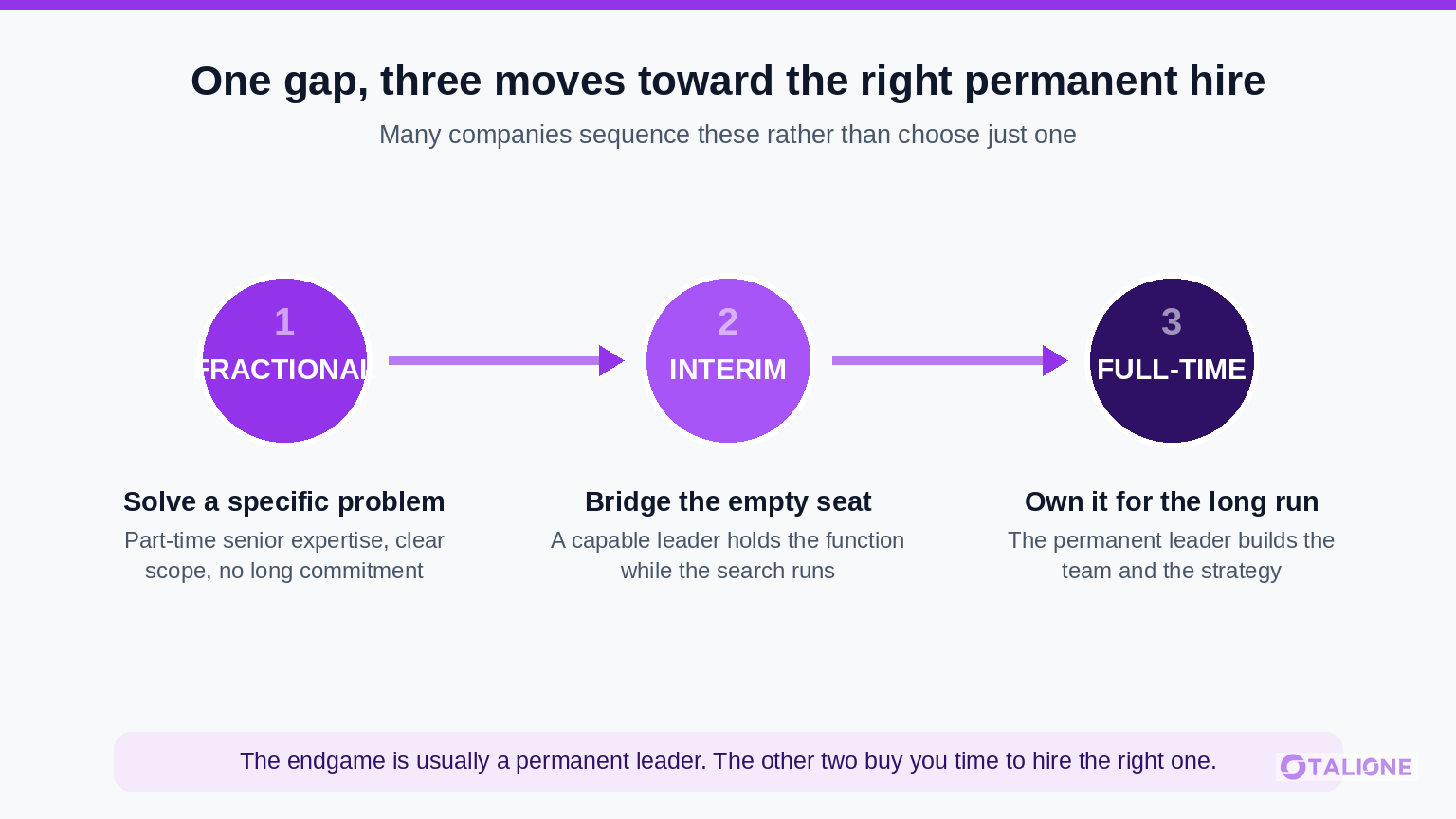
Sequencing works because each step reduces the risk of the next. You learn what good looks like before you commit to it, you keep the function running while you search, and you hire the permanent leader against a real, tested mandate instead of a guess. When the permanent search needs to run quietly, because the seat is still filled or the market should not know, a confidential executive search keeps the process discreet until you are ready to move.
Frequently asked questions
Is a fractional executive the same as a consultant?
No. A consultant advises and hands you a recommendation. A fractional executive holds a real seat, owns outcomes, and makes decisions inside your business, just on a part-time basis and for a set scope.
How long should an interim executive stay?
Long enough to stabilise the function and hand over cleanly, usually three to nine months. If an interim leader stretches past a year with no search in progress, the arrangement has quietly become a permanent hire without the commitment or accountability of one.
Is fractional or interim leadership cheaper than a full-time hire?
Fractional is almost always cheaper because you pay for part-time work with no long-term incentives. Interim can approach a full salary for the period but avoids equity and long severance. The cheapest option on paper is not always the least expensive once you account for lost momentum.
Can a fractional or interim leader convert to full-time?
Sometimes, and it can be a low-risk way to test fit. But an available fractional or interim leader is not automatically the right permanent hire, and treating the conversion as automatic skips the search that would surface a stronger candidate.
Which model is best for a first-time senior hire?
If you have never had leadership in a function, a fractional leader can define the role and prove the need before you commit to a permanent salary. Once the mandate is clear and the function needs daily ownership, move to a full-time hire.
Does Talione help with fractional and interim placements?
Talione focuses on permanent executive search across Canada, and we will tell you honestly when a fractional or interim step is the smarter first move so your eventual permanent hire lands on solid ground.
Hiring senior talent in Canada?
Talione helps companies hire 4× faster with zero upfront costs. Let's find your next great hire.
Hire TalentRelated Posts

When to Hire a CFO in Canada: Signs, Timing, and the Fractional Bridge
The real triggers to hire a CFO in Canada, how the role differs from a controller or VP Finance, when a fractional bridge makes sense, and what to screen for.

How to Stop a Counteroffer From Losing Your Executive Hire
A counteroffer looks like a money problem but is really a process problem. Here is the playbook to protect an executive hire from the first interview to the first day.
Executive Reference Checks: The Questions That Actually Predict Success
Reference checks are where most senior hires are quietly saved or lost. Who to call, the questions that predict success, and the red flags to chase before you make the offer.