
Executive Reference Checks: The Questions That Actually Predict Success
Reference checks are where most senior hires are quietly saved or lost. Who to call, the questions that predict success, and the red flags to chase before you make the offer.

By the time an executive reaches your reference stage, everyone in the room wants the hire to happen. The interviews went well, the team is tired of the empty seat, and the candidate has started to feel like a colleague. That is exactly when a reference check stops being diligence and quietly turns into a formality that confirms a decision already made.
The best hiring leaders do the opposite. They treat references as the last real chance to test a senior hire before it costs them a year. Done well, the reference stage is not a box to tick. It is where you find the one thing three rounds of interviews could not surface.
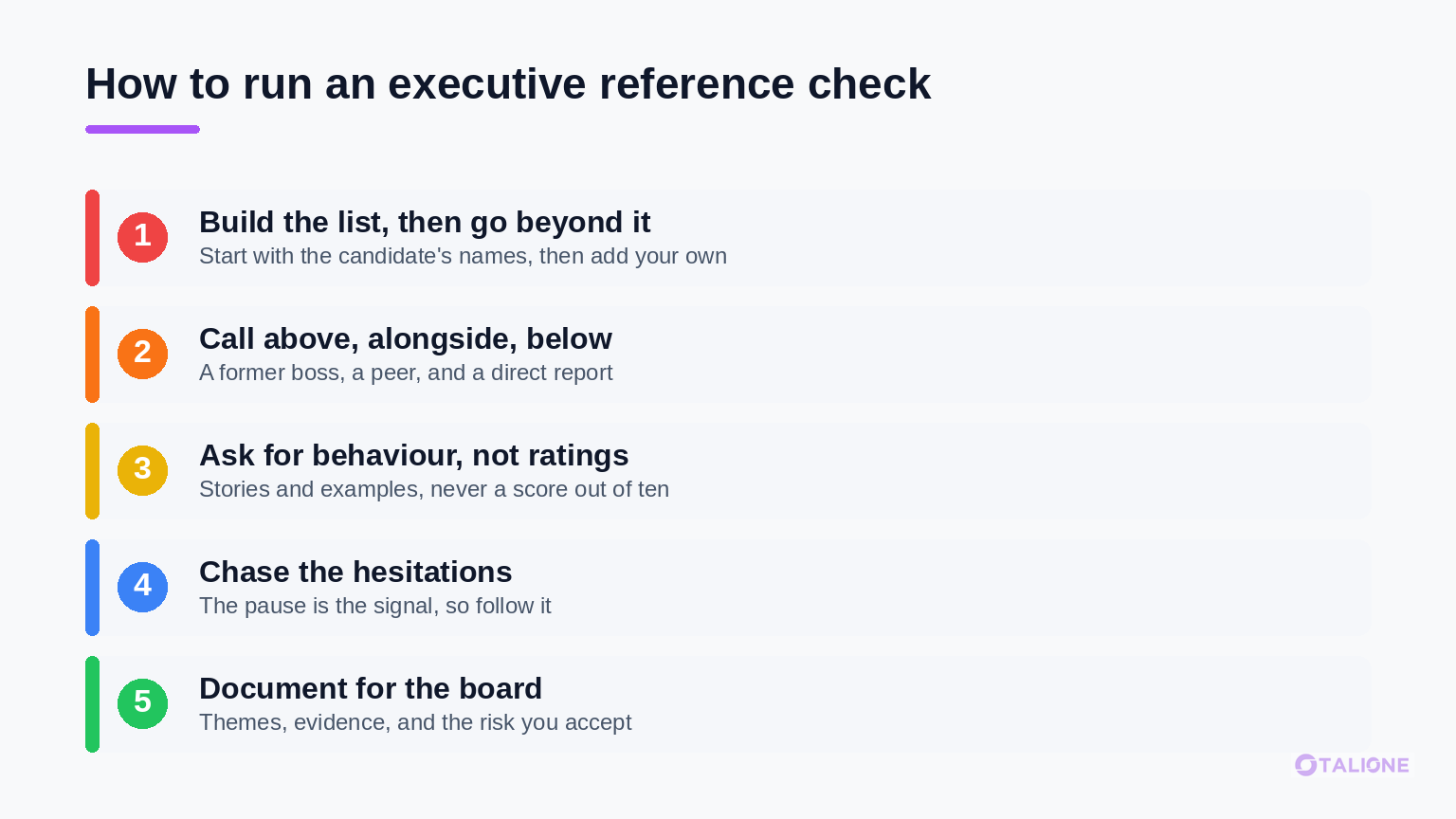
The short version. Reference checks are where most senior hires are quietly saved or lost, yet they are the step most often rushed. Run them like an investigation, not a formality. The hiring leader makes the calls, you go beyond the candidate's own list, and you ask for specific behaviour instead of a rating. The pause before an answer usually tells you more than the answer itself.
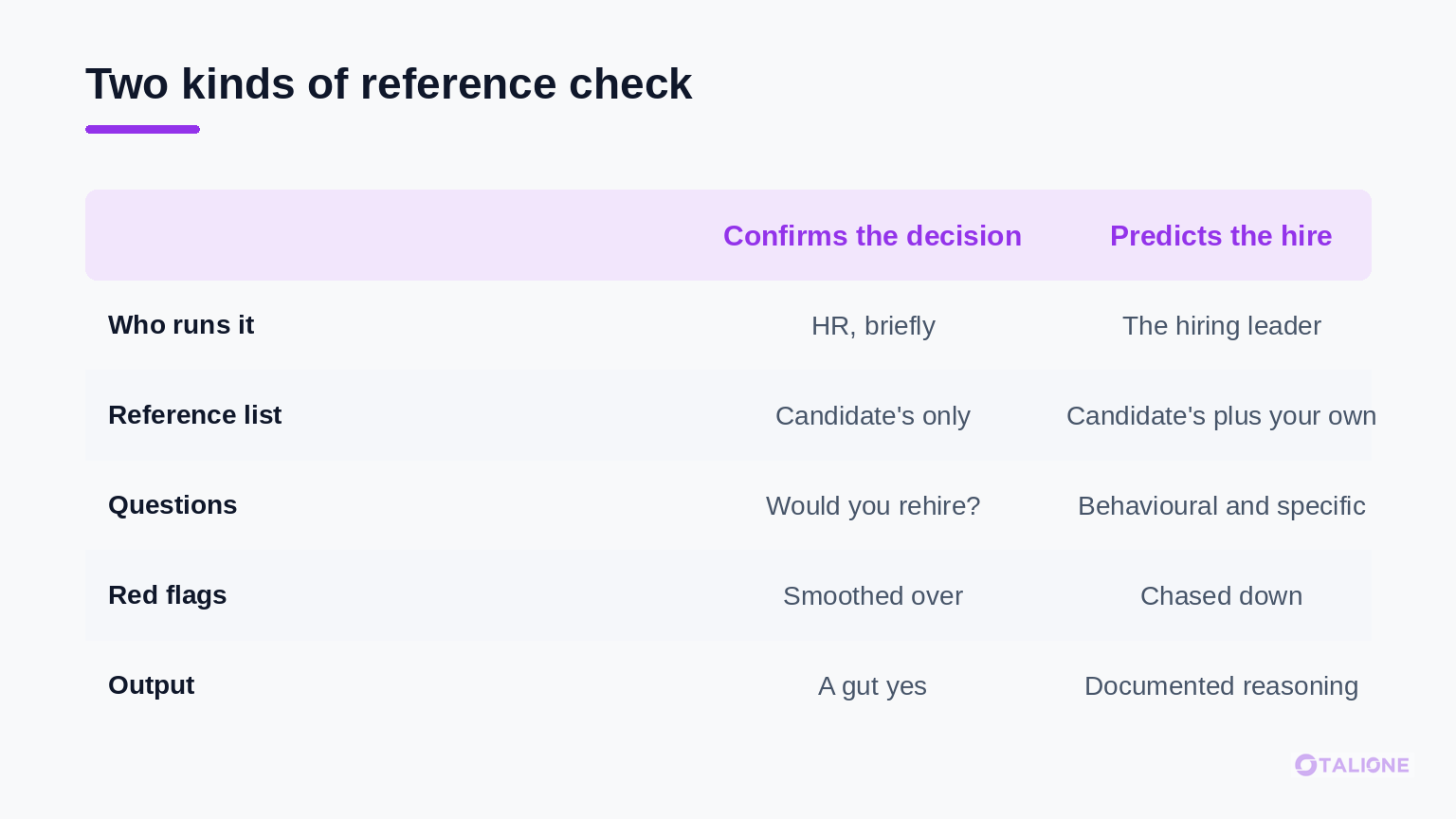
- The hiring leader should run the calls, not delegate them to a quick box tick.
- Speak to someone above, alongside, and below the candidate, plus one reference you sourced yourself.
- Ask for stories and examples, never a score out of ten.
- Chase every hesitation. The soft flag people let slide is the one that ends the hire in year one.
- Document themes and evidence so the board sees the reasoning, not just the verdict.
On this page
- Why reference checks decide senior hires, not interviews
- Who to call for an executive reference check
- The one reference from a hard period
- The questions that actually predict success
- How back-channel and off-list references work
- The red flags people let slide
- Documenting references for the board
- Frequently asked questions
Why do reference checks decide senior hires, not interviews?
Because an interview shows you how a candidate performs under observation, while a reference tells you how they actually behaved when no one was auditioning. Senior candidates are, almost by definition, excellent in the room. They have sat on both sides of the table for twenty years. A polished interview confirms they can present. It does not tell you what they were like to work for in month nine of a hard year.
References reveal patterns that a few hours of conversation cannot. Did people grow under them or leave? Did they own the miss or narrate around it? Did the results they claim survive contact with someone who was there? At the executive level, the stakes make this gap expensive. A senior hire that unravels does not cost you one salary. It costs you the search, the ramp, the momentum of a team that bet on the wrong leader, and the better part of a year before you can start again. That is the same math that makes the true cost of an executive search worth protecting, and it is why the reference stage deserves more rigour than it usually gets.
Who should you call for an executive reference check?
Speak to people from three levels around the candidate, above, alongside, and below, and add at least one reference you found yourself. Each level sees a different person, and the gap between those views is where the truth lives.
- Above. A former manager or board member. This is where you test judgement, accountability, and how the candidate handled being managed. Ask what they were genuinely responsible for, not what the title implied.
- Alongside. A peer who held no authority over them. Peers see how someone behaves when they cannot pull rank: whether they share credit, whether they are political, whether other leaders wanted them in the room.
- Below. A former direct report. This is the reference candidates control least, and it predicts retention better than any other call. Did people follow this leader, grow under them, and stay? A strong hire almost always leaves a trail of people who would work for them again.
- Off-list. At least one person you reached through your own network, not from the candidate's sheet. More on that below.
Treat the candidate's list as the starting point, not the boundary. It is curated by design. That is not dishonest, it is human, but it means the names you were handed are the ones most likely to say yes. The references that move a decision are usually the ones you had to go and find.
What is the one reference from a hard period, and why does it matter?
Ask for a reference from a role or project that did not go well, because how a leader behaves when things break is the truest signal you will get. Anyone looks good describing a win. You learn who someone is by how they talk about a loss, and by how the people around them remember it.
Ask the candidate directly: "Tell me about a stretch that went sideways for you. Who did you work most closely with then?" Then call that person. Listen for ownership versus blame, for how they treated the team under pressure, and for what they actually changed afterward. A candidate who cannot name a hard period, or who frames every setback as someone else's doing, has told you something important before you dial a single number.
Which questions actually predict executive success?
Behavioural questions that ask for specific examples, not rating questions that invite a polite summary. "Was she a good leader?" gets you a yes. "Walk me through a decision she made that you disagreed with" gets you the truth. Trade every general question for one that forces a story.
These questions consistently earn a real answer:
- Walk me through a decision they made that you pushed back on. What did they do with the pushback?
- What did they inherit, and what did it look like when they left?
- Who on their team grew the most under them, and why?
- Where did they need the most support to be effective?
- How did they handle the quarter or project that missed the number?
- If you were building a team tomorrow, what role would you give them, and what role would you not?
That last question is the one to hold for the end of every call, in plain words: "Would you hire them again, into what role, and is there any hesitation I should know about?" The "into what role" and "what role would you not" framing is what makes it work. It gives an honest referee permission to be specific about limits without feeling like they are torpedoing a friend. A flat "yes, of course" delivered a half second too fast is itself an answer.
How do back-channel and off-list references work?
A back-channel reference is someone who worked with the candidate but was not on their list, reached through your own network, and it is often the most candid conversation you will have. Senior markets in Canada are small. If you are hiring a VP or director, you very likely know someone who overlapped with your finalist, or know someone who does.
These references have no script and no incentive to sell, which is exactly why they are valuable and why they need care. Keep them lawful and professional. Never contact the candidate's current employer without written consent, and protect the confidentiality of a candidate who is still in their seat. This is the same discipline that governs a confidential executive search, and it matters just as much at the reference stage. Frame the call simply: "I am doing diligence on someone I respect. Is there anything I should understand?" Focus on work behaviour, weigh a single off-list voice as one data point rather than a verdict, and stay well clear of anything personal or tied to a protected ground.
What red flags do people let slide, and how do you chase them?
The dangerous flags are the soft ones, a hedge, a change of subject, a too-perfect answer, and you chase them by slowing down and asking again rather than moving on. Loud red flags are easy. Nobody hires past "he was let go for cause." The hires that fail usually cleared references that felt fine in the moment.
Watch for a few specific tells:
- The pause and the pivot. "She was, well, she was really strong with clients." The beat before the answer, and the swerve to a different strength, is where the concern lives.
- The overcorrection. Only strengths, no growth area, no single thing they would improve. Everyone who has actually worked with a person can name one. A referee who cannot is protecting them.
- The narrow reference. Three names who all reported the same relationship over the same six months. It is one view wearing three coats.
Chase them by naming what you noticed, gently: "You paused there, tell me more about that." Ask the same question a second way later in the call. Take a concern one referee raised and test it with another. And never explain a flag away because the seat is empty and you are tired of the search. The pressure to fill the role is precisely why the flag is getting waved through, and it is the same instinct that turns a slow search into a rushed close.
How do you document references so the board sees the reasoning?
Write up themes and evidence, not a verdict, so the board and the CEO can see the risk they are choosing to accept. A one line "references checked out" protects no one. A short reference memo turns a gut call into a decision the organisation can stand behind.
Keep it to a single page: who you spoke to and their relationship to the candidate, the two or three themes that came up consistently, the concerns you heard and how you tested them, the residual risk you are accepting, and the specific onboarding actions that address it. That last part is the quiet payoff. A well-run reference process does not end at the offer, it writes the first page of the new leader's first ninety days, because the gaps you surfaced are exactly what to support early. Diligence like this is also one of the core principles of hiring senior talent, and it is a fair thing to expect from any search partner you engage.
Running a senior search and want the reference stage done properly?
Talione manages executive search across Canada end to end, from a scoped brief to a reference-backed close, with zero upfront cost.
Frequently asked questions
How many references should you check for an executive hire?
Aim for roughly five to eight conversations spread across levels, including at least one you sourced yourself. Depth beats count. Three thorough calls that chase the hesitations are worth more than eight that read from the same script.
Should HR or the hiring manager make the calls?
The hiring leader, or the search partner running the mandate. A peer-level conversation earns candour that a form or a junior coordinator never will. HR can coordinate and keep it compliant, but the leader who will manage this person should be on the important calls.
Can you check references without alerting the candidate's current employer?
Yes. Work from past roles and your own network, and never contact the current employer without the candidate's written consent. Protecting a candidate who is still in their seat is standard practice in confidential search.
What is the single best reference question?
"Would you hire them again, into what role, and into what role would you not?" It surfaces genuine fit and honest limits in one breath, and the speed and tone of the answer tell you as much as the words.
Are executive reference checks legal in Canada?
Yes, when they stay focused on job-related behaviour and performance. Keep questions clear of protected grounds such as age, family status, and health, and stick to what the person observed at work.
What should you do with a lukewarm reference?
Treat it as data, not an automatic veto. Chase why it was lukewarm, weigh it against the wider pattern, and decide with your eyes open. One soft call among many strong ones is a question to resolve, not a reason to walk on its own.
Hiring senior talent in Canada?
Talione helps companies hire 4× faster with zero upfront costs. Let's find your next great hire.
Hire TalentRelated Posts

When to Hire a CFO in Canada: Signs, Timing, and the Fractional Bridge
The real triggers to hire a CFO in Canada, how the role differs from a controller or VP Finance, when a fractional bridge makes sense, and what to screen for.
How to Stop a Counteroffer From Losing Your Executive Hire
A counteroffer looks like a money problem but is really a process problem. Here is the playbook to protect an executive hire from the first interview to the first day.
Fractional, Interim, or Full-Time? Choosing the Right Executive Leadership Model
Fractional, interim, or full-time executive? Compare cost, timeline, and fit, and learn how to choose the right leadership model for your senior gap.