
Executive Search Firm vs In-House Recruiter: Which Should Run Your Senior Hire?
Your in-house team fills the funnel. A director or VP hire is usually won in the passive market. Here is when an executive search firm earns its fee, and when it does not.

Every senior hire eventually forces the same question: do we run this search ourselves, or bring in an executive search firm? The honest answer depends less on your budget and more on where the right candidate actually sits today, and whether your internal team has the reach and the room to go and get them.
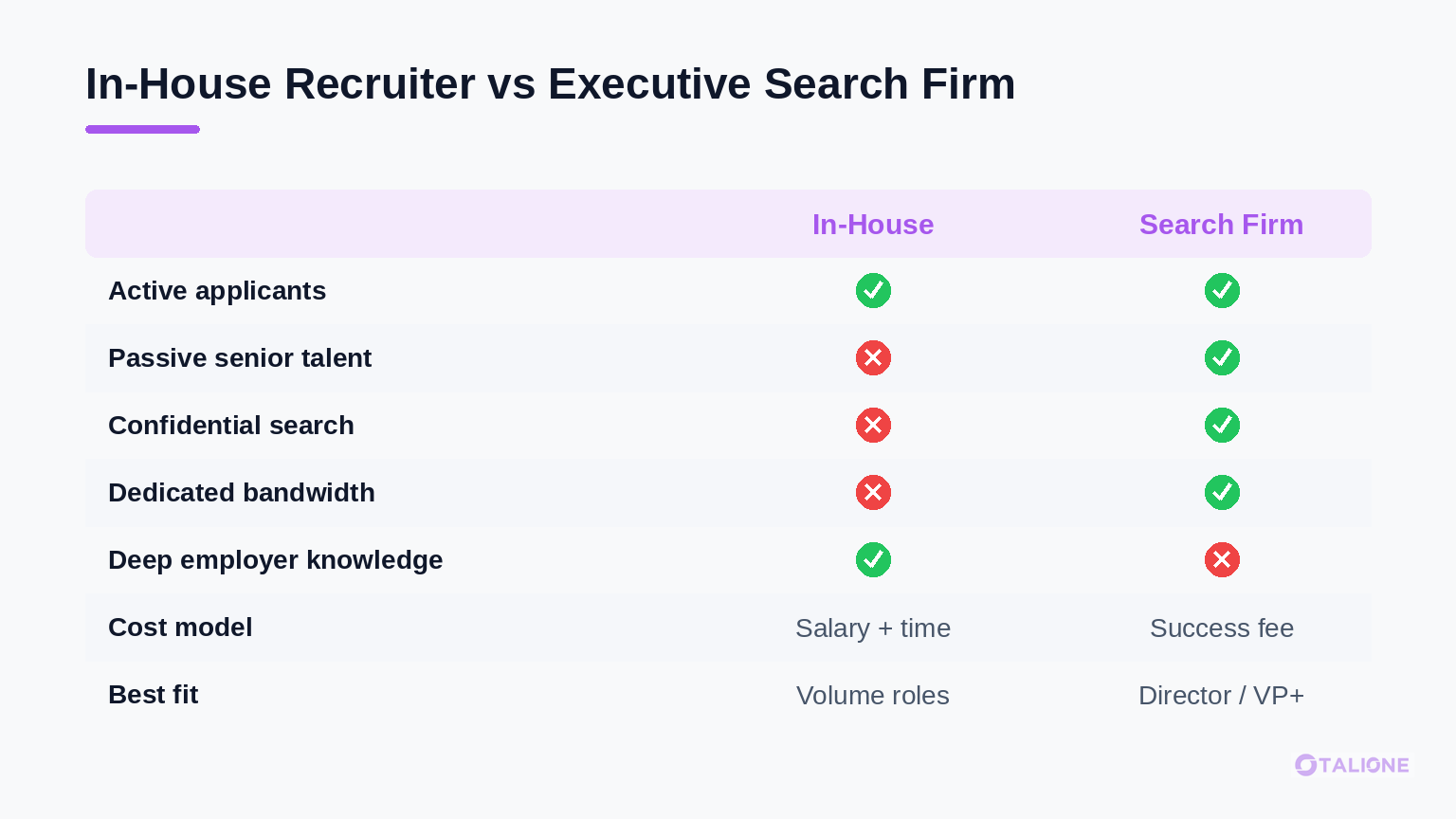
Short answer: An in-house recruiting team is built to fill an active funnel, and it does that well. A director or VP hire is usually won in the passive market, quietly, against a clock your team does not have the bandwidth to protect. Use your internal team for volume and repeatable roles, and an executive search firm for senior, confidential, or hard-to-reach mandates.
- In-house recruiters excel at active applicants, employer brand, and cost control on roles you hire for often.
- The strongest senior candidates are usually passive and will not answer a job post or a cold internal note.
- Confidential and off-market searches need a neutral outside party your staff and competitors cannot trace back to you.
- The real choice is not free versus a fee: internal time, a longer vacancy, and a mis-hire all carry a price.
- A hybrid model fits when you have a strong team but one seat that must be filled from the top of the market.
- What an internal recruiting team does well
- Why internal teams miss passive senior candidates
- Where confidentiality and discretion tip the decision
- Whether bandwidth is the real problem
- What each option actually costs
- How to decide which to use
- When a hybrid model works best
- Frequently asked questions
What does an internal recruiting team do well?
A good in-house team is one of the most cost-effective assets a company has. Because it lives inside the business, it knows the culture, the managers, and the story that makes a candidate say yes. On roles you hire for regularly, an analyst, an engineer, a regional sales lead, an internal team is usually faster and cheaper than any outside option.
Internal recruiters also own the things a firm never can: your employer brand, your applicant pipeline, your careers page, and the relationships with hiring managers that make an offer land. When a role has a genuine active market, people who will apply, respond, and move quickly, your own team is the right answer.
Where it stalls is at the very top of the org chart. A director, VP, or C-suite seat is a different kind of search, and the skills that fill the funnel are not the skills that win a passive, senior, and often confidential hire.
Why do internal teams miss passive senior candidates?
Because the best senior candidate is almost never looking. They are employed, performing, and not scrolling job boards. Directionally, most of the working population is passive at any given time, and that share only rises as you move up in seniority. A person running a business unit will not apply to your posting and will quietly ignore a cold message from an internal recruiter they have never heard of.
Reaching that person takes three things an internal team rarely has spare: a live map of who is doing the job well across the market, a warm and credible way in, and the neutrality of a third party. A senior leader will take an exploratory call from a discreet outside recruiter long before they will signal interest directly to a company they do not yet trust. That neutral distance is exactly what an executive search firm sells.
Where do confidentiality and discretion tip the decision?
Some searches cannot run in the open. You may be replacing a leader who is still in the seat, entering a new market before you want competitors to notice, or filling a role so sensitive it can never be posted. The moment a search like that touches your internal systems and staff, it can leak, and a leak can cost you the incumbent, the team, or the deal.
An outside firm is a buffer. It approaches the market on your behalf without naming you until the right moment, holds candidates under an NDA, and keeps your own people out of a conversation they should not be part of. If discretion matters at all, this usually settles the question on its own. We go deeper on this in our guide to confidential executive search.
Is bandwidth the real problem with senior hiring?
More often than companies admit, yes. An internal recruiter is usually measured on filling many open roles at once. A senior search does not reward that rhythm. It needs weeks of concentrated market mapping, patient outreach, and careful assessment, and that work is the first thing to slip when ten other requisitions are on fire.
A senior seat left open is not a saved salary. It is a slow leak of momentum, decisions, and the people who report to it.
This is the quiet cost most plans ignore. Every extra week a VP role stays empty, projects stall and the team drifts. A firm exists to protect that timeline, because the search is the only thing on its desk. If speed is your concern, our executive search timeline guide breaks down where the weeks actually go.
What does each option actually cost?
The comparison is rarely free versus a fee, and treating it that way leads to the wrong call. Running a senior search in-house has real costs: the salary hours your team diverts from other roles, a vacancy that drags on longer without dedicated focus, and the outsized risk of a mis-hire at a level where a wrong choice can cost a full year of lost progress.
An executive search firm charges a fee, directionally in the range of 20 to 35 percent of first-year compensation, and success-based models such as ours only charge when a hire is made, with nothing upfront. The right question is not which line item is smaller. It is the total cost of getting the hire right, weighed against the far larger cost of getting it wrong. For the full breakdown, see our guide to executive search costs in Canada.
How do you decide which to use?
Match the method to the role and the situation, not to habit. As a rule of thumb, your internal team should own high-volume and mid-level hiring, while senior, confidential, or hard-to-source mandates belong with a firm.

If you are also weighing which type of firm to engage once you decide to go outside, our buyer checklist for choosing a search firm covers the questions to ask before you sign, and our comparison of retained versus contingent search explains the fee models.
When does a hybrid model work best?
A hybrid split is often the most efficient answer for companies with a capable talent team. The firm does what only an outside party can, mapping the passive market, making the discreet first approach, and delivering a vetted shortlist. Your internal team then does what it does best, running the final interviews, selling the culture, and closing the offer.
The same logic applies across a hiring plan: bring a firm in for the confidential top layer and keep the rest of the funnel in-house. Used this way, you pay for outside reach only where it changes the outcome, and your team stays close to every hire it can genuinely win on its own. The principles behind either path are the same ones in our five principles for hiring senior talent.
Have a senior seat that has to be filled from the top of the market?
Talione runs confidential, success-based executive searches across Canada, with zero cost upfront. We reach the leaders your posting never will.
Start a search conversation with TalioneFrequently asked questions
Can an in-house recruiter handle a VP search?
Sometimes, if the role has an active market and does not need to stay confidential. The trouble is that most VP-calibre candidates are passive and take exploratory calls only from a neutral third party, and a busy internal team rarely has the weeks of focused market mapping the search demands.
Are executive search firms worth the fee?
When the hire is senior, confidential, or hard to reach, usually yes. The fee is small next to the cost of a seat that stays empty for months or a wrong hire at the top. On a success-based model you also pay nothing unless a placement is made.
What is the difference between a search firm and a headhunter?
The terms overlap. In practice, an executive search firm runs a structured, research-led process across the whole market for senior roles, while headhunting describes the direct, passive-candidate outreach that sits at the centre of that process.
How is this different from retained versus contingent?
That comparison is between two firm models. This one is broader: it weighs using any outside firm against running the search with your own internal team. Once you decide to go outside, the retained versus contingent choice is the next step.
Should a startup use a search firm for its first executive hire?
Often it should, precisely because a first senior hire is high-stakes and the founder has no internal recruiting bench for that level. A firm brings market reach and an objective read at the moment a wrong call is most expensive.
Hiring senior talent in Canada?
Talione helps companies hire 4× faster with zero upfront costs. Let's find your next great hire.
Hire TalentRelated Posts

When to Hire a CFO in Canada: Signs, Timing, and the Fractional Bridge
The real triggers to hire a CFO in Canada, how the role differs from a controller or VP Finance, when a fractional bridge makes sense, and what to screen for.

How to Stop a Counteroffer From Losing Your Executive Hire
A counteroffer looks like a money problem but is really a process problem. Here is the playbook to protect an executive hire from the first interview to the first day.
Fractional, Interim, or Full-Time? Choosing the Right Executive Leadership Model
Fractional, interim, or full-time executive? Compare cost, timeline, and fit, and learn how to choose the right leadership model for your senior gap.