
How to Choose an Executive Search Firm in Canada: A Buyer's Checklist
A buyer's checklist for choosing an executive search firm in Canada: the fee models, the eight questions to ask, and the guarantees to demand.


The short answer
Choose an executive search firm in Canada by how it works a mandate, not by brand name. The four things that predict a good hire are the fee model and whose interests it serves, how many searches each consultant carries at once, the reach of the off-market network, and the strength of the replacement guarantee and references. A zero upfront, success-based firm carries the risk alongside you, so it is paid only when you actually hire.
- Ignore the logo. A famous brand does not run your search, one consultant does.
- Ask the eight questions below before you sign anything.
- Retained, contingent, and success-based fees each create a different incentive.
- Demand a replacement guarantee, an off-limits list, and two references from the last year.
- Zero upfront aligns the firm with the outcome you actually care about: the hire.
On this page
- What does an executive search firm actually do?
- How do you choose an executive search firm in Canada?
- What do the fee models tell you?
- Why does the consultant workload per search matter?
- What guarantees and references should you demand?
- What are the red flags of a weak search firm?
- How does a zero upfront model change the incentives?
- Frequently asked questions
What does an executive search firm actually do?
A good executive search firm does one thing that job boards and in-house teams cannot do at speed: it reaches the senior leaders who are not looking. Most directors, VPs, and C-suite executives who would be right for your role are employed, quiet, and invisible to a public posting. Search exists to map that market, approach those people discreetly, and carry them through a process to a signed offer.
That means you are not buying a stack of resumes. You are buying market mapping, confidential outreach, assessment, reference work, and the steady hand that keeps a passive candidate engaged while their current employer tries to keep them. When you compare firms, you are really comparing how well each one does that work, and how its business model shapes the effort it puts in.
A search firm does not sell you candidates. It sells you the time and the network to reach the people who would never answer your posting.
How do you choose an executive search firm in Canada?
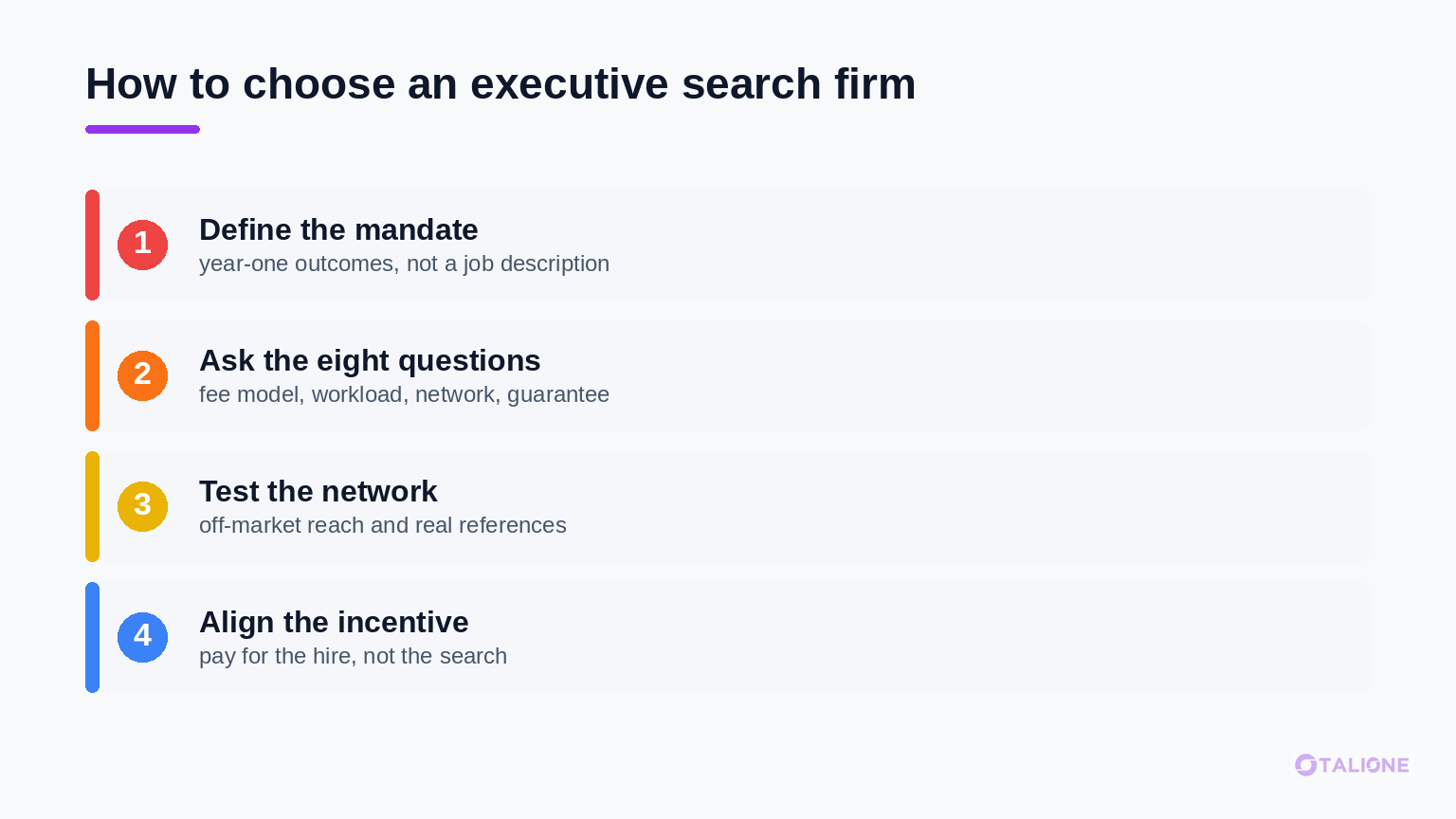
Choose the firm by interrogating the mandate, not the brand. Before you sign, put these eight questions to anyone who wants to run your search. The answers separate a true search partner from a resume forwarder.
- Who personally runs my search, and how many others are they carrying right now? You want a named consultant and a real number.
- How do you get paid, and what happens if you do not place anyone? The fee model is the incentive. Make it explicit.
- How much of your work is off-market versus your existing database? A database is a starting point, not a search.
- What is your replacement guarantee, and how often do you invoke it? A firm that never replaces a hire is either lucky or not tracking.
- What is your off-limits list? The companies they cannot approach because those firms are clients. A long list shrinks your talent pool.
- Can I speak to two clients from searches you closed in the last year? Recent, relevant, reachable references only.
- How will you keep this search confidential? Especially if you are replacing a leader who is still in the seat.
- What does your timeline look like, stage by stage? Compare it against a realistic executive search timeline for Canada.
If a firm cannot answer these crisply, that is your answer. The best firms welcome the interrogation because it is exactly how they qualify a search too.
What do the fee models tell you?
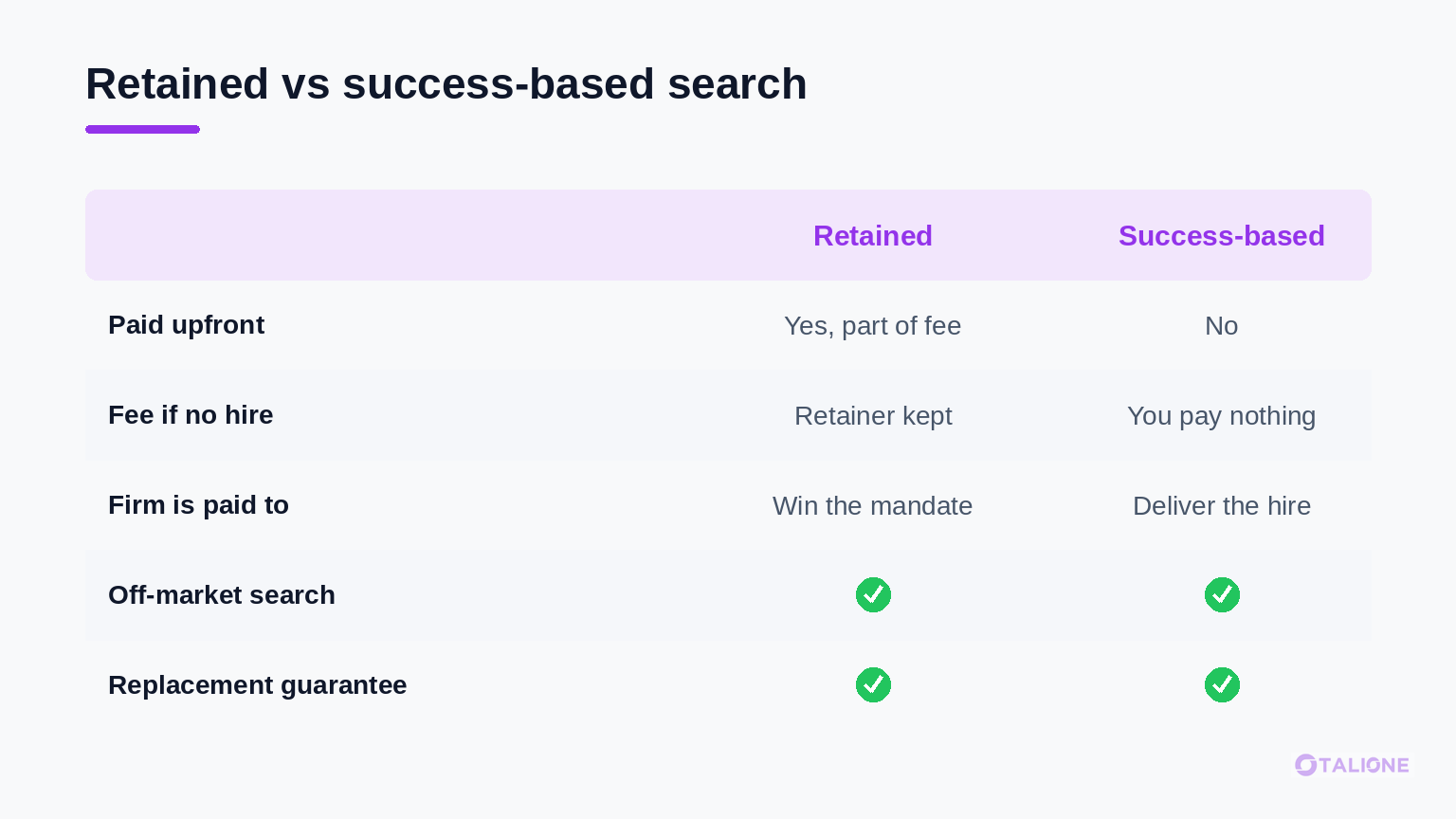
The fee model is the single most revealing thing about a search firm, because it decides who carries the risk. There are three common structures in Canada, and each one points the firm's effort in a different direction.
Retained search charges a fee, usually 25 to 35 percent of first-year compensation, split into thirds: one at kickoff, one at shortlist, one at placement. You pay whether or not anyone is hired. It buys dedicated focus, but the firm is paid to win and work the mandate, not strictly to deliver the hire.
Contingent search is paid only on placement, but the firm is usually running many roles at once and racing other recruiters to submit resumes first. Speed of submission beats depth of search. It can work for lower-stakes roles and struggles with confidential or hard-to-fill ones.
Success-based search, the model Talione runs, charges zero upfront and is paid only when you hire. It carries the dedication of retained work with the risk-sharing of contingent, because the firm only earns by delivering the actual outcome you want. For a fuller breakdown, see our guide to retained versus contingent search in Canada and what an executive search actually costs.
Why does the consultant workload per search matter?
Because the brand does not run your search, one human being does, and that person only has so many hours. A consultant carrying two active mandates can personally map a market, make the calls, and manage every candidate relationship. A consultant carrying ten cannot, no matter whose logo is on the door. Workload per consultant is the quiet number that predicts your experience more than the firm's size.
Ask directly how many searches your consultant is running this quarter, and who does the actual outreach. If the answer is a junior researcher blasting InMails while the senior name you met stays on the pitch, you are buying a brand, not a search. This is also why a boutique with focused consultants often outperforms a large firm on a single important hire.
Weighing a firm for a senior hire?
Talione runs director and VP searches across Canada with zero upfront cost. You pay only when the right leader signs.
What guarantees and references should you demand?
Demand three things in writing: a replacement guarantee, a clear off-limits list, and recent references. A replacement guarantee means that if the hire leaves or is let go within a set window, commonly 6 to 12 months, the firm runs the search again at no new fee. It is the firm putting its own work behind its judgement.
The off-limits list matters because every firm is contractually barred from approaching its own clients. A firm with a long client roster in your industry has fewer people it can legally recruit for you. Ask for it before you sign, not after.
References should be recent and specific. Two clients from searches closed in the last year, in roles close to yours, whom you can actually call. Vague praise from three years ago is not a reference. While you are assessing rigour, it is worth reading how strong firms handle the principles of hiring senior talent.
What are the red flags of a weak search firm?
The clearest red flag is a resume forwarder posing as a search firm. If a firm sends you three candidates within 48 hours, it did not run a search, it queried a database. Real search takes weeks because reaching passive leaders takes weeks. Other warning signs:
- The senior name disappears after the pitch. You met a partner, then a junior does all the work.
- No clear fee logic. The firm cannot explain what happens if it fails to place.
- Pressure to sign an exclusive fast. Confidence does not need urgency tactics.
- Only database candidates. No off-market outreach means no real reach.
- No replacement guarantee. The firm will not stand behind its own hire.
- Vague or ancient references. Nothing recent, relevant, or reachable.
How does a zero upfront model change the incentives?
A zero upfront, success-based model changes the one thing that matters: what the firm is paid to do. When there is no retainer, the firm does not earn by winning the mandate or by staying busy. It earns only when you hire the right person and they start. That single fact aligns the firm with your outcome from the first call.
It also lowers your risk. You are not writing a large cheque before you have seen a single candidate, and you are not locked into a firm that stops trying once the retainer is banked. The firm's motivation to keep working is renewed every week the seat stays open, because until it is filled, the firm has been paid nothing. For senior hires, where the cost of the wrong person is measured in a lost year and not a lost fee, that alignment is worth more than any brand name. Pair the right firm with a clear view of executive compensation in Canada and you are set up to close.
Frequently asked questions
How much does an executive search firm cost in Canada?
Most firms charge 25 to 35 percent of the hire's first-year total compensation. Retained firms bill it in stages whether or not you hire, while success-based firms like Talione charge zero upfront and are paid only on placement. See our full executive search cost guide.
What is the difference between retained and contingent search?
Retained search is paid in stages regardless of outcome and buys dedicated focus. Contingent search is paid only on placement but the firm juggles many roles and competes on speed. Success-based sits between them: dedicated focus with payment only on the hire.
How long does an executive search take in Canada?
A typical director or VP search runs about 90 to 120 days to a signed offer, longer with notice periods. The firm's process and workload per consultant are the biggest levers. See the executive search timeline.
Should I use a search firm or an in-house recruiter?
In-house recruiters are strong for volume and known talent pools. A search firm earns its place on senior, confidential, or hard-to-fill roles that need off-market outreach and discretion your team cannot run alone.
What is a replacement guarantee?
It is a written commitment that if the hire leaves or is let go within a set window, often 6 to 12 months, the firm reruns the search at no additional fee. Always confirm the length and terms before signing.
Hiring senior talent in Canada?
Talione helps companies hire 4× faster with zero upfront costs. Let's find your next great hire.
Hire TalentRelated Posts
Retained vs Contingent Executive Search in Canada: Which Model Should You Use?
A plain-English, Canada-specific guide to retained vs contingent executive search: how each model works, what it costs, when to use which, and how to vet a search partner.