
Retained vs Contingent Executive Search in Canada: Which Model Should You Use?
A plain-English, Canada-specific guide to retained vs contingent executive search: how each model works, what it costs, when to use which, and how to vet a search partner.

TL;DR
Retained and contingent are the two classic ways to pay for executive search. Retained means an exclusive mandate with fees that start upfront and a deeper, more discreet process; contingent means you pay only when someone is hired, which suits faster, lower-risk mid-level roles. For senior, confidential or scarce-skill hires in Canada, a retained-grade process wins, and the honest question is whether you can get that rigour without the upfront fee.
- Retained = exclusive, staged fees, deep vetting, reaches passive talent, built for C-suite and VP roles.
- Contingent = pay on hire only, lighter vetting, faster, best for mid-level and high-volume roles.
- Match the model to the role using seniority, confidentiality, urgency, budget and market scarcity.
- Fees are similar across both models, roughly 20 to 33 percent of first-year compensation; the real difference is when and whether you pay.
- Talione runs a retained-grade process on a zero-upfront basis, so you only pay on a successful placement.
On this page
- What is the difference between retained and contingent search?
- How do you decide which model to use?
- When is retained search worth the upfront cost?
- Where does the contingent model break down at the executive level?
- Is there a third option: retained rigour without the upfront fee?
- How do you vet a search partner, whatever the model?
- FAQ
What is the difference between retained and contingent executive search?
The difference is how you pay and how deep the search goes. Retained search is an exclusive engagement: you appoint one firm, pay a portion of the fee upfront and the rest in stages, and in return get a deep, structured process that targets passive senior candidates and vets them thoroughly. Contingent search is pay-on-success: you may hand the same role to more than one recruiter, you pay nothing until someone is hired, and the process is faster and lighter, which suits mid-level roles with a larger candidate pool.
Retained is the model built for the top of the org chart. It exists because the best executives are almost never applying to job ads; they have to be identified, approached discreetly and persuaded to move. That work is front-loaded and labour-intensive, so the firm asks for commitment in the form of exclusivity and an upfront retainer. Contingent search flips the risk onto the recruiter: they only get paid if they deliver, so they naturally chase the roles that are quickest to fill.
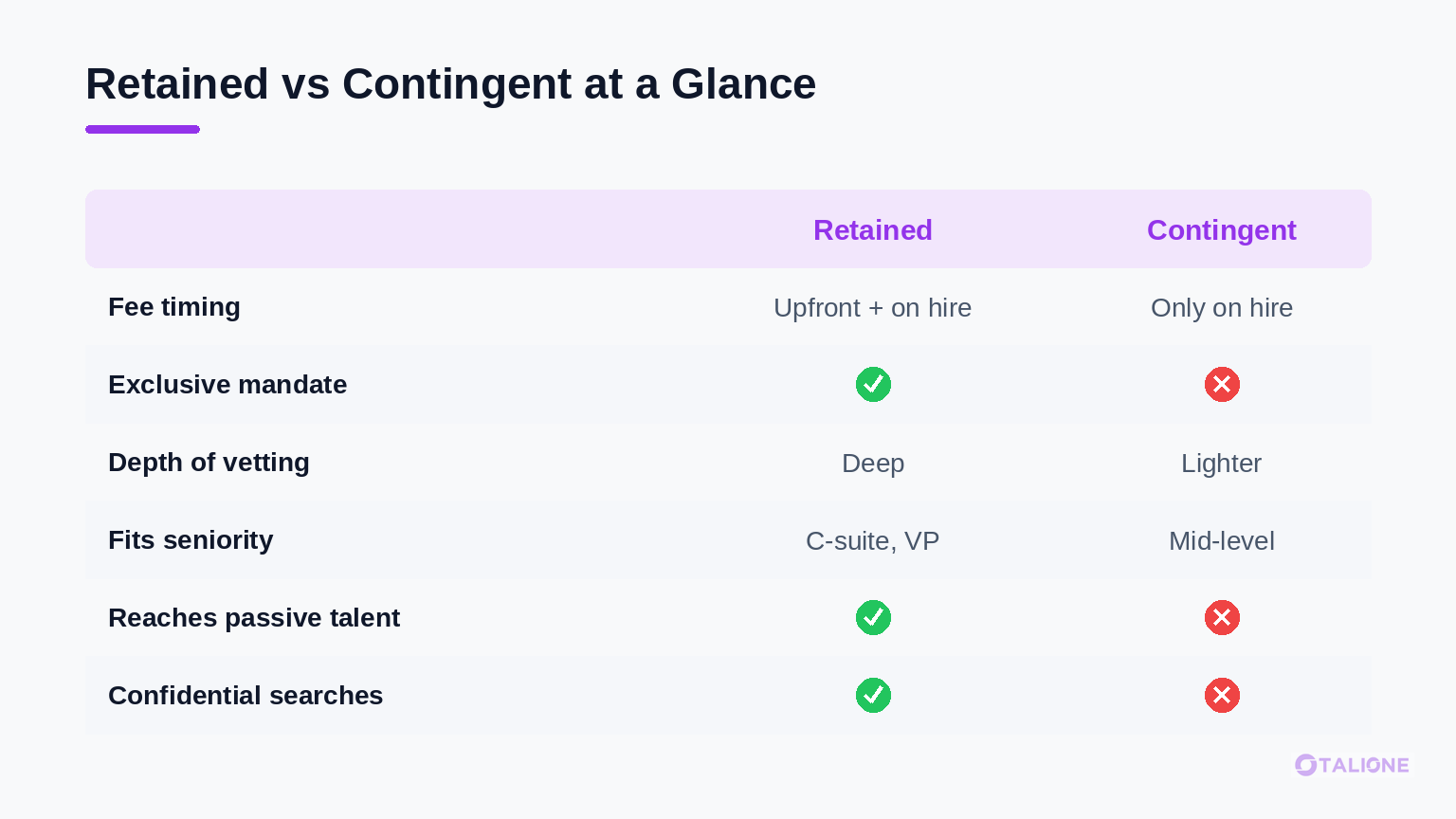
One clarification that trips up hiring leaders: the headline fee is usually similar in both models, commonly in the range of 20 to 33 percent of the executive's first-year total compensation. Retained does not cost more because it is retained; it simply bills earlier and in stages. For a full breakdown, see our guide to how much executive search costs in Canada.
How do you decide which model to use?
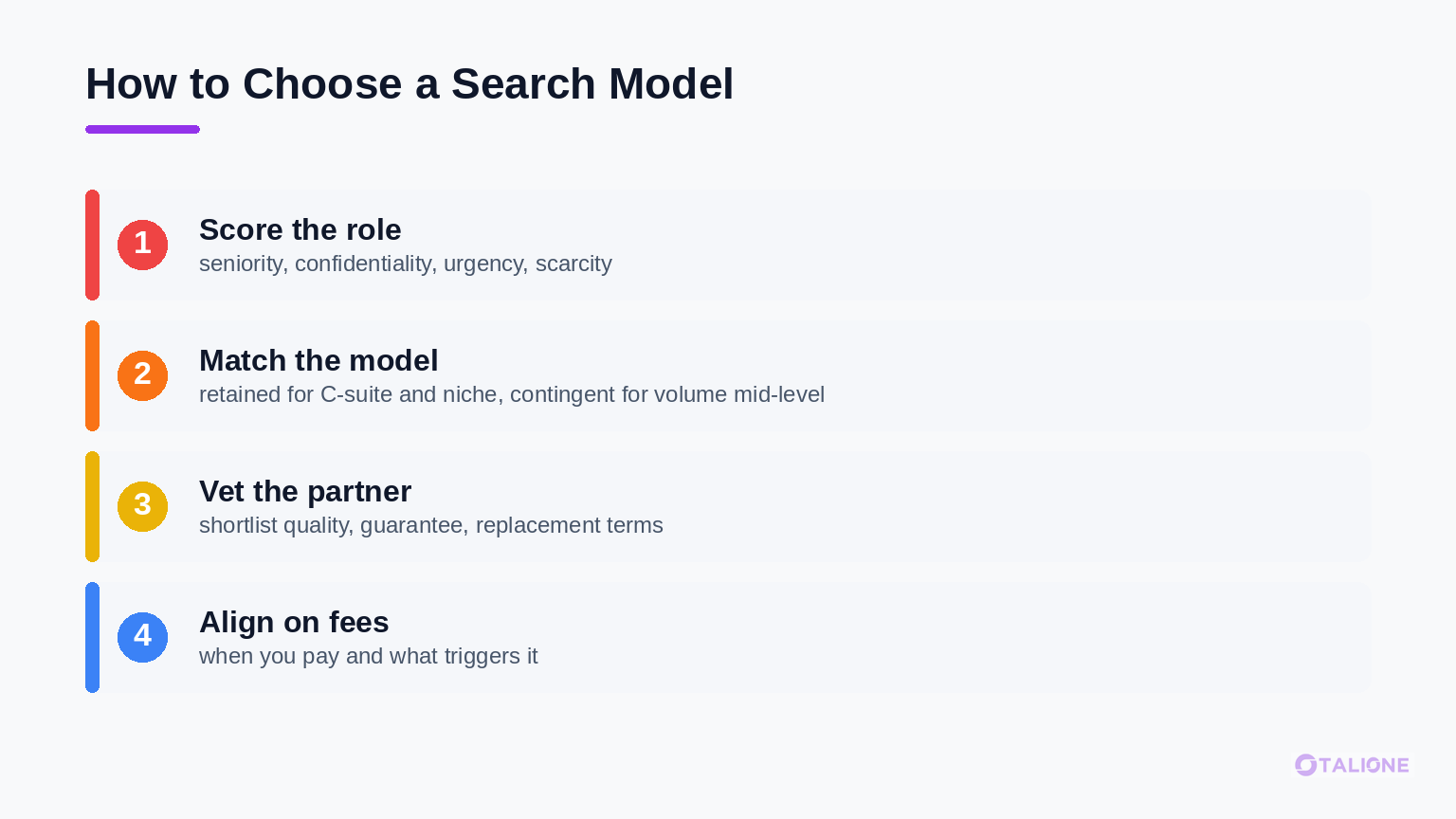
Score the role against five factors, then let the pattern point you to a model. If most of your answers sit at the demanding end, you want a retained-grade process. If the role is mid-level, non-confidential and easy to source, contingent can be the efficient choice.
- Seniority: C-suite, VP and board roles lean retained; manager and individual-contributor roles can go contingent.
- Confidentiality: replacing a sitting executive or hiring against a competitor demands the discretion of a retained mandate. See our note on confidential executive search.
- Urgency: a fast, well-understood role can suit contingent; a critical hire you cannot afford to get wrong suits a deeper process.
- Budget structure: the question is less about total cost and more about whether you can commit fees upfront or need to pay only on success.
- Market scarcity: the rarer the skill set, the more you need direct outreach to passive candidates, which is retained territory.
The model is a means, not the goal. The goal is a shortlist of executives who would never have answered a job ad, vetted well enough that you would bet the quarter on them.
When is retained search worth the upfront cost?
Retained search earns its upfront fee whenever the cost of a wrong or slow hire is large, which is nearly always true at the executive level. Four situations make the case clearly.
The role is C-suite or VP. The pool of qualified, available leaders is small, and the strongest are passive. An exclusive mandate gives one firm the incentive to map the entire market rather than skim whoever is easy to reach.
The search is confidential. If the incumbent does not yet know they are being replaced, or you do not want competitors to read your strategy from your job postings, you need a single accountable partner working quietly, not several recruiters advertising the role.
The skill set is niche. When you need a specific mix of sector, stage and functional depth, direct headhunting beats waiting for the right person to apply. That targeted outreach is the core of the retained process.
The stakes are high and the timeline is real. A structured, exclusive search gives you predictable progress, a committed partner and a genuine shortlist, rather than a stream of loosely matched resumes. For what a realistic schedule looks like, see our executive search timeline for Canada.
Where does the contingent model break down at the executive level?
Contingent search breaks down at the top because its incentives reward speed over fit. When a recruiter is paid only on a hire, and may be racing other recruiters on the same role, the rational move is to submit candidates quickly, not to spend weeks courting a passive executive who might say no.
That creates three predictable problems for senior hires. First, coverage is shallow: contingent recruiters work the active, easy-to-reach candidates and rarely map the full market. Second, the best passive candidates stay out of reach, because approaching and persuading them is slow work that the contingent model does not pay for until the very end. Third, a role handed to several recruiters can start to look shopped around, and strong executives quietly avoid opportunities that feel like they are being marketed to everyone at once.
None of this makes contingent search bad. For a mid-level role with a deep candidate pool and no confidentiality concern, it is often the faster, more economical choice. The mistake is using a mid-level tool for a top-level job.
Want retained-grade rigour without the upfront fee?
Talione runs a deep, exclusive-quality executive search and you only pay on a successful placement.
Is there a third option: retained rigour without the upfront fee?
Yes, and it is where the market has been moving. The old choice forced hiring leaders to pick between the depth of retained search and the pay-on-success safety of contingent. Talione's model collapses that trade-off: you get a retained-grade process, an exclusive mandate, direct outreach to passive talent, deep vetting and a real replacement guarantee, on a zero-upfront basis, so you only pay when a placement is made.
The point is not that upfront fees are wrong. The point is that the upfront fee was never the thing you were buying. What you actually want is the rigour: a partner who maps the whole market, protects your confidentiality and stands behind the hire. If you can get that rigour and keep your risk on the recruiter until the job is done, you have the best of both classic models. For the principles behind a strong senior hire, see our 5 principles for hiring senior talent in Canada.
How do you vet a search partner, whatever the model?
Whichever model you choose, the firm matters more than the label. Ask the same four questions of any partner before you sign.
- Shortlist quality: how do they source, and how many candidates on a typical shortlist are passive rather than active applicants? A shortlist of people who applied is not executive search.
- Guarantee and replacement terms: if the hire does not work out, what exactly happens, and for how long? Get the window and conditions in writing.
- Process and communication: what does the search look like week by week, and who is accountable to you throughout?
- Fee structure and triggers: what do you pay, when, and what event triggers each payment? Clarity here prevents every common dispute.
Get honest answers to those four and the retained-versus-contingent question mostly answers itself. You are no longer buying a model; you are buying a result, delivered by a partner you can hold to account.
Frequently asked questions
Is retained or contingent search better for a VP role in Canada?
For most VP and C-suite roles a retained-grade process is better, because the strongest candidates are passive and need to be approached directly, vetted deeply and handled confidentially. The classic trade-off is the upfront fee, which is why a retained-grade process on a zero-upfront basis is worth seeking out.
Can you run more than one contingent recruiter on the same executive role?
You can, but at the executive level it usually backfires. Competing recruiters optimise for speed over fit, the same candidates get contacted twice, and strong passive candidates avoid roles that look shopped around.
What does executive search cost in Canada?
Traditional fees run roughly 20 to 33 percent of first-year total compensation in both models. The difference is timing: retained bills in stages starting upfront, contingent bills only on a hire.
What is a replacement guarantee?
It is a commitment that if the placed executive leaves or is let go within a set window, often 6 to 12 months, the firm re-runs the search at no additional fee. Always confirm the length and the exact conditions in writing.
Does zero upfront cost mean lower quality?
Not on its own. Zero upfront describes when you pay, not how the search is run. Ask whether the process itself is retained-grade: exclusive mandate, direct outreach to passive talent, deep vetting and a real guarantee.
How do I know which model my role needs?
Score the role on seniority, confidentiality, urgency, budget structure and market scarcity. The more of those that sit at the demanding end, the more you need retained-grade depth rather than a light contingent search.
Hiring senior talent in Canada?
Talione helps companies hire 4× faster with zero upfront costs. Let's find your next great hire.
Hire TalentRelated Posts

How to Choose an Executive Search Firm in Canada: A Buyer's Checklist
A buyer's checklist for choosing an executive search firm in Canada: the fee models, the eight questions to ask, and the guarantees to demand.