
When Should You Hire Your First VP? A Founder's Timing Guide
Hire your first VP when you have a repeatable motion to scale, not when revenue hits a number. The readiness signals, what to prove first, and how to scope the role.

TL;DR
Hire your first VP when you have a repeatable motion to scale, not when revenue crosses a milestone or the org chart starts to look thin. The real trigger is repeatability: a proven, documented way of winning that one or two people already execute without the founder in the room. Hire before that and you pay a senior salary, often plus equity, for someone to invent a playbook they were never brought in to build.
- The most common first-VP mistake is hiring too early and too senior at the same time.
- Readiness is a set of signals, not a revenue number: a stable ICP, a repeatable motion, and one or two people already succeeding.
- Founders should prove the function works before handing it to a VP.
- Match the profile to your stage: a builder for zero to one, a scaler once the motion is proven.
- If you are close but not ready, a fractional leader can bridge the gap and help scope the eventual full-time hire.
Every founder reaches the moment where the work outgrows the people doing it. Sales is stretched, marketing is a side project, or operations is held together by heroics and spreadsheets. The instinct is to hire a VP and buy back some sanity. Sometimes that is exactly right. Often it is a year and a large chunk of equity spent on the wrong hire at the wrong time.
This guide is about timing. It covers the signals that tell you a first VP will succeed, what you need to prove before you make the hire, how to match the profile to your stage, and what to do when you are close but not quite ready.
On this page
- What is the biggest first VP hiring mistake?
- When is a startup actually ready for its first VP?
- What readiness signals matter by function?
- What must the founder prove before hiring?
- Should you hire a builder or a scaler?
- Why does the wrong first VP cost you a year?
- How do you scope the role around year-one outcomes?
- Can a fractional leader bridge the gap until you are ready?
- Frequently asked questions
What is the biggest first VP hiring mistake?
The biggest mistake is hiring too early and too senior at the same time. A founder feels the pain of a function that is not scaling, so they reach for the most impressive resume they can find, usually someone who ran that function at a company two or three stages ahead. That leader arrives expecting a pipeline, a team, a budget, and an enablement layer that does not exist yet. Within a few months they are frustrated, the founder is disappointed, and the relationship quietly ends.
The failure rate here is not small. Directional industry estimates put first VP of Sales failures as high as seven or eight in ten, with an average tenure of roughly a year before the exit. Across executive hires more broadly, close to half stumble, and the cause is more often timing and fit than talent. The person was capable. They were simply the right leader for a company that did not exist yet.
The lesson is not to lower your bar. It is to hire for the stage you are in, not the stage you hope to reach next quarter.
When is a startup actually ready for its first VP?
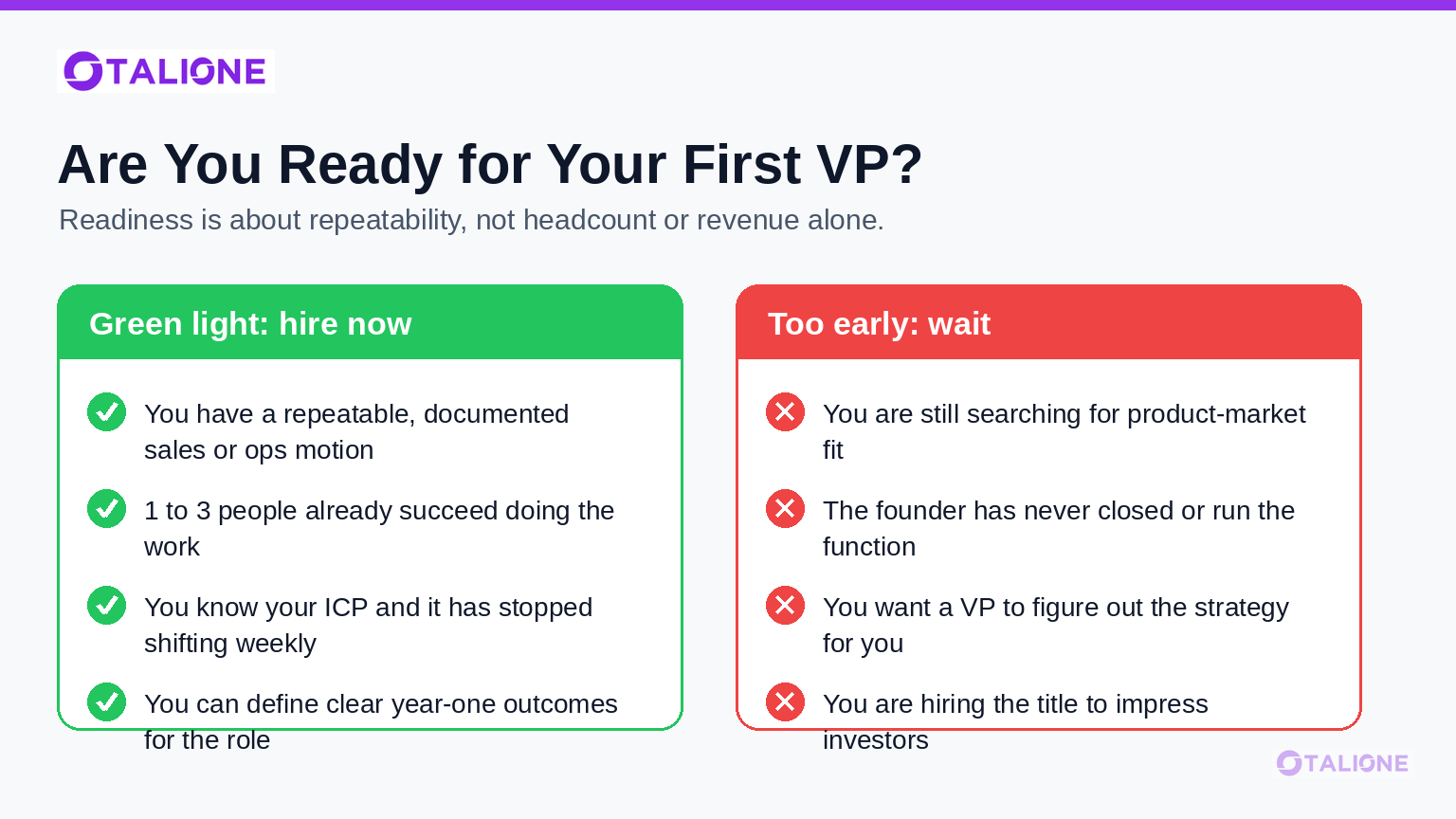
You are ready when you have a repeatable motion that a VP can scale, not when you hit a specific revenue number. Revenue milestones are a lagging clue, useful but not decisive. The decisive question is whether there is a proven, documented way of winning that already works without the founder personally driving every outcome.
Concretely, readiness usually shows up as a cluster of signals at once: a defined ideal customer profile that has stopped shifting week to week, a channel that produces predictable pipeline, consistent conversion through your process, and one or two people who are already succeeding in the role you want to scale. When those are green, a VP has something real to build on. When they are red, you are asking a VP to find product-market fit or invent a motion, which is founder work, not VP work.
For many software companies that readiness window lands somewhere around the first million in recurring revenue, but treat that as directional. Two companies at the same revenue can be in completely different places on readiness. Read the signals, not just the number.
The trigger to hire your first VP is repeatability, not revenue. If the motion only works when the founder is in the room, it is not ready to scale.
What readiness signals matter by function?
The core test is the same across functions, a repeatable motion, but the specific signals differ by role.
VP of Sales. You have closed enough deals yourself to know your ICP, your average deal size is stable, and at least one or two reps are hitting quota using a process you can describe. If the founder has never carried a number, hire a senior account executive or a head of sales first and prove the motion before you layer in a VP.
VP of Marketing. You know which one or two channels actually drive qualified pipeline, you have a message that resonates with a defined audience, and you need someone to scale and systematize demand rather than discover it. Hiring a VP to go find your positioning from scratch rarely works.
VP of Operations. The business has enough volume and complexity that coordination has become a real bottleneck, handoffs are breaking, and the founder is spending their days firefighting process instead of building the company. That is the signal that ownership needs to move to a dedicated leader.
Across all three, notice the pattern: the founder has already done the job well enough to hand over a working version of it. You are hiring someone to scale a proven thing, not to conjure it.
What must the founder prove before hiring?
Before hiring a first VP, the founder must prove the function works at a small scale under their own hand. That does not mean being the world's best salesperson or marketer. It means having personally established a motion that produces results predictably enough to describe, document, and defend.
There is a hard reason for this. When you hire a VP for a function you have never made work, you cannot evaluate them, coach them, or tell the difference between a bad hire and a hard market. You are outsourcing a problem you do not understand, which means you cannot manage it. When you hire a VP for a function you have made work, you can set real targets, recognize progress, and course-correct early.
Proving it also protects your credibility as a manager. A founder who has closed deals earns the respect of a VP of Sales. A founder who has never sold, telling a VP of Sales how to sell, invites exactly the friction that ends these relationships early. Do the job first, then hire someone to do it better and bigger.
Scoping your first VP hire?
Talione runs confidential, success-based executive searches across Canada, with zero upfront cost. We help you define the mandate and reach the senior leaders who never see a public job posting.
Start a conversationShould you hire a builder or a scaler?
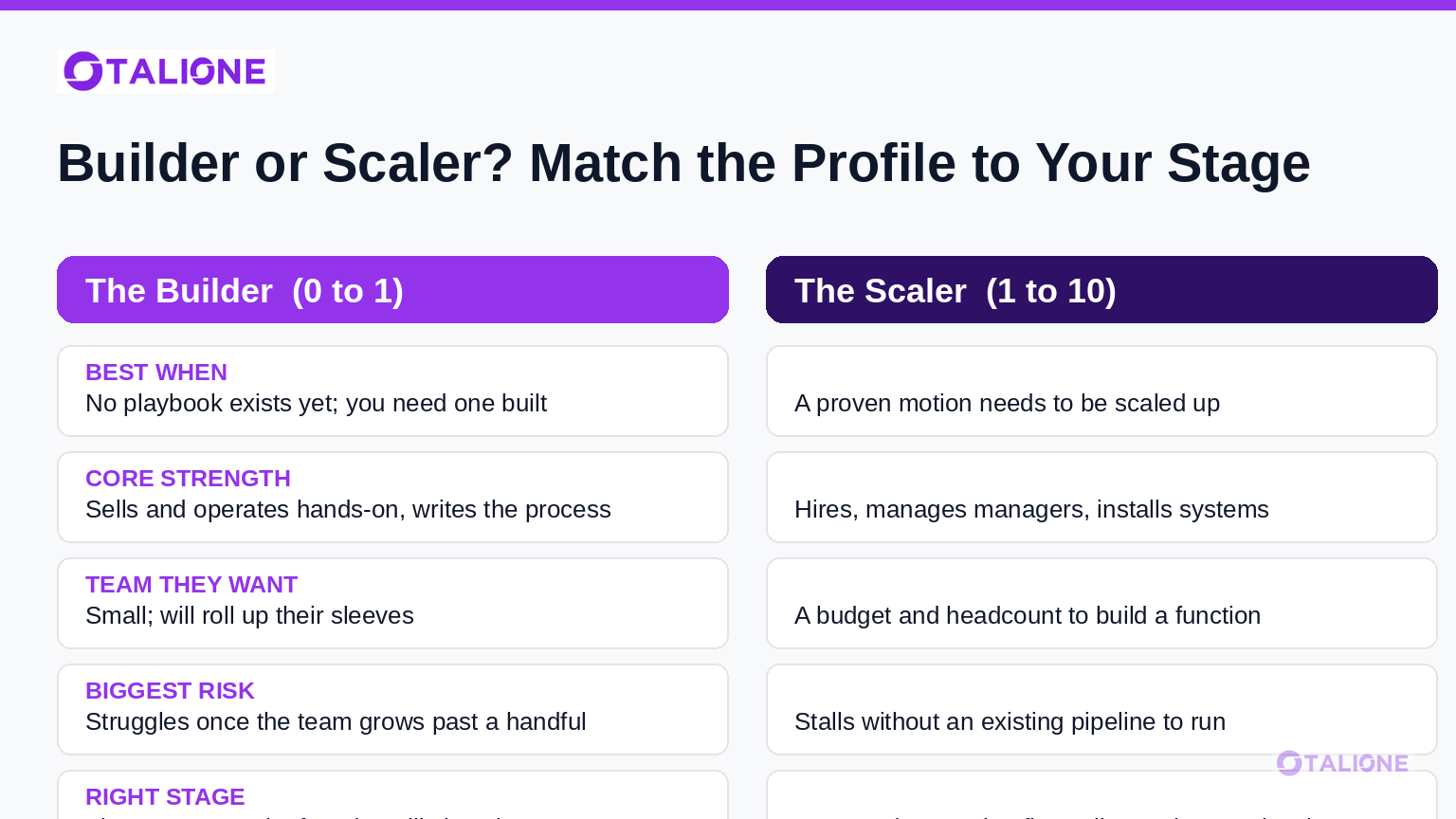
For your first VP, you almost always want a builder, not a scaler. The distinction matters more than the brand names on the resume. A builder thrives in the zero to one range: they will roll up their sleeves, sell and operate hands-on, and turn a rough motion into a repeatable one. A scaler is brilliant once a motion is proven, hiring managers, installing systems, and running a large team, but they often stall when there is no existing engine to run.
The classic first-VP mistake is hiring a polished scaler from a much larger company because the resume is impressive. They arrive expecting infrastructure, direct reports, and a mature pipeline, and when they find a scrappy team instead, both sides lose. Hire the builder who is energized by the messiness of your stage, and who has done the actual work recently, not just managed people who did it.
One practical filter: ask candidates to walk you through how they would build the function in your exact situation, with your team size and resources. Builders get specific and energized. Scalers tend to describe the org they would hire and the tools they would buy, which tells you they expect a stage you are not at yet.
Why does the wrong first VP cost you a year?
A wrong first VP costs a year because the damage is not just the salary, it is the lost time and the ripple through the team. The hire takes a few months to ramp, a few more before it is clear things are not working, and then you are back to searching, often having lost good people who were hired or unsettled along the way. Add the runway spent and the equity granted, and an early startup can lose a year of momentum it cannot get back.
The cost also compounds. While the wrong VP is in the seat, the founder often steps back from the function, assuming it is handled. Problems that a founder would have caught go unaddressed. Customers, candidates, and investors form impressions. By the time the seat is open again, you are not starting from where you were, you are starting from behind.
This is why timing is a risk decision, not just a talent decision. The safest way to protect against a costly miss is to hire only when the signals are green, and to scope the role tightly enough that success and failure are both visible early.
How do you scope the role around year-one outcomes?
Scope the role around two or three specific year-one outcomes, not a generic list of responsibilities. A job description that says a VP will own strategy, build the team, and drive growth tells a candidate nothing and gives you nothing to measure. A scoped mandate names the two or three problems this person must solve in their first year and what good looks like.
For a first VP of Sales, that might be moving from founder-led selling to a two or three person team hitting a defined quota, with a documented, repeatable process by the end of the year. For a VP of Operations, it might be a specific reduction in fulfillment time and a set of core processes owned and running without the founder. Write the outcomes first, then work backward to the profile and the seniority you actually need. Often you will find you need a strong builder, not the biggest title.
Getting this brief right is the highest-leverage thing you do in the whole hire. It aligns you and any hiring partner, it sharpens the search, and it gives the new leader a clear definition of success from day one. It also feeds directly into onboarding, so the person can hit the ground running rather than spending months guessing at what they were hired to do.
Can a fractional leader bridge the gap until you are ready?
Yes. When you feel the pain of a missing leader but the readiness signals are not yet green, a fractional or interim leader is often the smartest bridge. A fractional VP brings senior expertise part-time to solve a specific problem, at a fraction of the cost and commitment of a full-time hire, without locking you into the wrong person too early.
Used well, a fractional leader does more than hold the seat. They help you build the very repeatability that tells you when to hire full-time, and they can help write the year-one mandate for the permanent role based on what they learn. In effect, the three models can sequence: a fractional leader proves the motion and shapes the brief, an interim leader can hold a full-time seat while you search, and the permanent VP lands on a tested mandate rather than a guess. If you are weighing these options, our guide to choosing between fractional, interim, and full-time leadership walks through the trade-offs in detail.
When the signals finally are green, do not shortcut the hire itself. Scope the mandate, understand the true cost of an executive search and the timeline it realistically takes, benchmark executive compensation so your offer lands, and put a real first 90 days plan behind the person once they start. For the fundamentals that apply to any senior hire, see our five principles for hiring senior talent in Canada.
Frequently asked questions
What revenue should we be at before hiring a first VP of Sales?
There is no universal number, but many software companies reach readiness somewhere around their first million in recurring revenue. Treat that as directional. The deciding factor is a repeatable motion and one or two reps already succeeding, not the revenue figure itself.
Should my first senior sales hire be a VP or a head of sales?
If the founder has not yet proven the sales motion, hire a senior account executive or a head of sales who will sell hands-on and help establish the playbook. Bring in a VP once there is a proven motion to scale and a small team to lead.
How do I know if I am hiring too senior?
If a candidate expects a pipeline, a team, a budget, and enablement that you do not have, they are likely too senior for your stage. Ask how they would build the function with your current resources. A good fit gets specific and energized rather than describing the org they would hire.
Is a fractional VP a waste of money if I will hire full-time later?
Not if you use it to build readiness. A fractional leader can establish the motion, deliver near-term results, and help you scope the permanent role, so your eventual full-time hire lands on a proven mandate instead of a guess.
How long does it take to hire a first VP once we are ready?
A senior search commonly runs a few months from a well-defined brief to a signed offer, longer with notice periods. Starting with a tightly scoped, outcome-based mandate is the single biggest thing that keeps it on track.
What is the most common reason first VP hires fail?
Timing and stage fit, not talent. Most failures trace back to hiring too early, hiring too senior, or handing over a function the founder never made work, which leaves no way to evaluate or coach the new leader.
Hiring senior talent in Canada?
Talione helps companies hire 4× faster with zero upfront costs. Let's find your next great hire.
Hire TalentRelated Posts
Signs It Is Time to Replace an Executive, and How to Do It Discreetly
How to read the honest signals that a senior leader is not working, and run a discreet, confidential transition without unsettling your team or tipping off the market.