
Signs It Is Time to Replace an Executive, and How to Do It Discreetly
How to read the honest signals that a senior leader is not working, and run a discreet, confidential transition without unsettling your team or tipping off the market.

Every board eventually faces the leader who is not working out. The numbers have slipped, the team is quieter than it should be, and the conversations you keep having are the same ones you had two quarters ago. You know something has to change. What you may not know is how to move without triggering an exodus, spooking your best customers, or handing a competitor the news that your senior bench is thin.
Replacing an executive is the highest-stakes people decision a company makes. Done late or loudly, it costs you a year of momentum and a chunk of your credibility. Done deliberately and discreetly, it can be almost invisible from the outside. This is a practical guide to reading the signals honestly and running the transition with discipline.
The short answer
The hardest call a CEO or board makes is rarely who to hire. It is admitting that a senior leader is not working, then moving them out without unsettling the team or tipping off the market. The signals are almost always visible for months before anyone acts. Here is how to read them honestly and run a discreet transition.
- Replace rather than coach when missed targets, departing talent, and unchanged behaviour all point the same way.
- Waiting is the default failure. The cost compounds every quarter you delay the decision.
- You can run a full search while the seat is still filled, with no public posting.
- Protect the incumbent's dignity and the team with a planned overlap and a single clean announcement.
- When you cannot post the role, a confidential search keeps the move quiet until you are ready.
On this page
- The signals it is time to replace an executive
- Why waiting too long is the default failure
- Decide before the team or the market decides for you
- Running a search while the seat is still filled
- Protecting the incumbent's dignity and the team
- What a discreet executive transition looks like
- Frequently asked questions
What are the signs it is time to replace an executive?
It is time to replace an executive when the same performance gap survives clear feedback, your strongest people start leaving because of them, and you have quietly stopped trusting them with your hardest problems. One bad quarter is not a signal. A pattern that does not respond to coaching is.
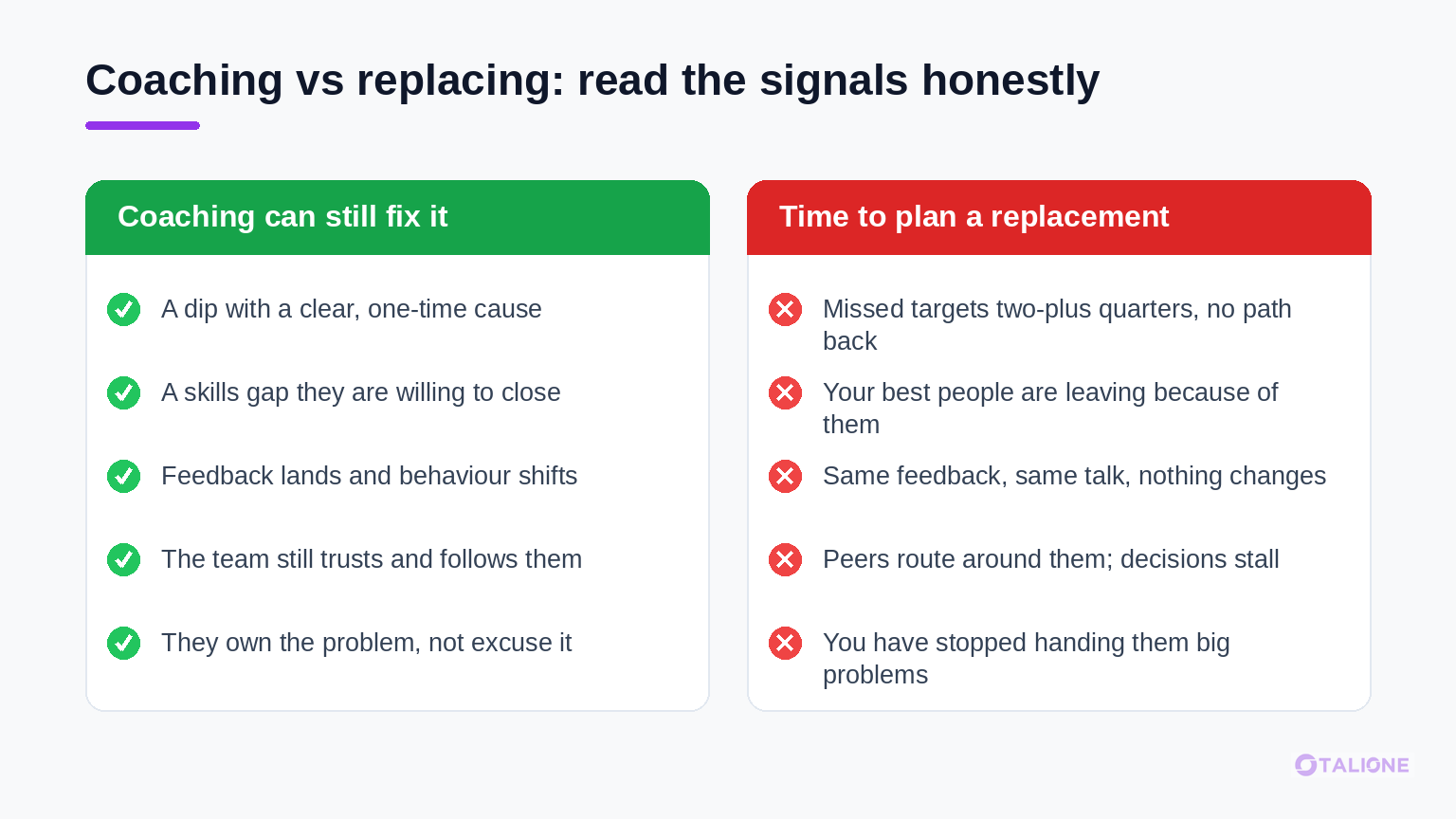
The trap is treating every senior stumble as a coaching problem. Some are. A capable leader hitting a rough patch with a clear, one-time cause, a skills gap they are genuinely working to close, feedback that visibly shifts their behaviour: those are worth investing in. The situation that calls for a replacement looks different, and it usually shows up as a cluster, not a single event:
- Missed targets across two or more quarters with no credible path back. Not a miss with a plan, a miss with excuses.
- Your best people are leaving, and the exit conversations point at this leader. Senior talent votes with its feet long before it complains.
- The same feedback, the same conversation, no change. When behaviour does not move after a direct, documented conversation, it will not move on its own.
- Peers route around them. Decisions stall, cross-functional work slows, and other leaders quietly stop looping them in.
- You have stopped handing them the big problems. If you notice you are working around your own executive, part of you has already decided.
Values and culture matter as much as output. A leader who hits the number while eroding trust is a slower, more expensive version of the same problem. When you scope the replacement, be honest about what actually broke, because that is what your next hire has to be built to fix.
Why is waiting too long the default failure?
Waiting is the default failure because the cost of an underperforming executive compounds quietly while the cost of acting feels loud and immediate. So boards almost always move later than they should, often by six to twelve months, and pay for the delay in ways that never show up on a single line of the budget.
Consider what a lingering senior gap actually drains. Your team spends months managing around a leader instead of being led. Good people update their resumes. Initiatives that needed a decisive owner drift. And every week you tolerate the gap, you are teaching your best performers what your standards really are. The salary you are still paying is the smallest part of the bill.
The reason we wait is rarely the evidence. It is the sunk cost of the original hire, the discomfort of a hard conversation, and the hope that one more quarter will turn it around. Naming that bias is most of the cure. If you have written the case twice in your head, you are not early. You are already late.
An underperforming executive is rarely a person problem to keep managing. It is a decision you have already made and have not yet acted on.
How do you decide before the team or the market decides for you?
You decide first by forcing a real decision: write the case in one page, set a date to act, and align privately with your board chair before anyone else is involved. If you do not decide, someone else will. The team decides through attrition, and the market decides when a competitor poaches the people you should have protected.
The one-page case is the forcing function. Put the pattern in writing: the missed outcomes, the feedback given and the response, the impact on the team, and the specific year-one outcomes the role has to deliver next. If you cannot make that case clearly, you may not be ready, and that is useful to know too. If you can, the ambiguity that keeps you stuck disappears.
Deciding early also buys you the one thing a late decision never has: time to run a proper, quiet search before you make any change. That is what turns a painful scramble into a controlled transition. It is also why the best moves look effortless from the outside. The work happened months before the announcement.
Can you run a search while the seat is still filled?
Yes. At the senior level, running a search while the incumbent is still in place is the norm, not the exception. It is called a confidential search, and it is built precisely for the situation where you cannot post the role, cannot tell the team, and cannot let the market read the signal.
A confidential search never touches a public job board. The mandate is scoped privately, candidates are approached off-market under strict discretion, and the shortlist is vetted quietly before you ever have to make a change. Done well, the incumbent keeps performing their duties, the team keeps working, and no competitor learns that a key seat is in play. We cover the full mechanics in our guide to confidential executive search in Canada.
Plan for the timeline. A senior replacement typically runs on the same clock as any executive hire, and you should read our executive search timeline before you set a change date, so the overlap is planned rather than improvised. Because our model is success-based with zero upfront cost, you can start the quiet search now and only commit when the right successor is ready to sign.
Need to move on a leader without the market knowing?
We run confidential, zero-upfront executive searches so you can line up the successor before you make a single change. No public posting, no signal to competitors.
Start a confidential searchHow do you protect the incumbent's dignity and the team?
You protect the incumbent's dignity by deciding the exit terms, the message, and the timing before the conversation happens, and you protect the team by controlling how and when the news lands. A rushed, leaky transition damages everyone, including the leaders who stay and watch how you handle it.
Start with legal and the exit package. Agree the terms with counsel before you sit down, so the conversation is respectful and final rather than a negotiation that drags on and leaks. Treat the departing executive as someone whose reputation still matters, because your remaining team is watching, and so is every candidate who will later check your references from the other side of the table.
On communications, discipline beats speed. Decide who needs to know before the announcement (usually a very small circle), agree a single consistent message, and announce once rather than letting rumour fill the gap. Have the successor ready so the story is continuity, not crisis. When the new leader arrives, invest in a real first 90 days onboarding plan so the transition reads as an upgrade rather than a disruption.
What does a discreet executive transition look like?
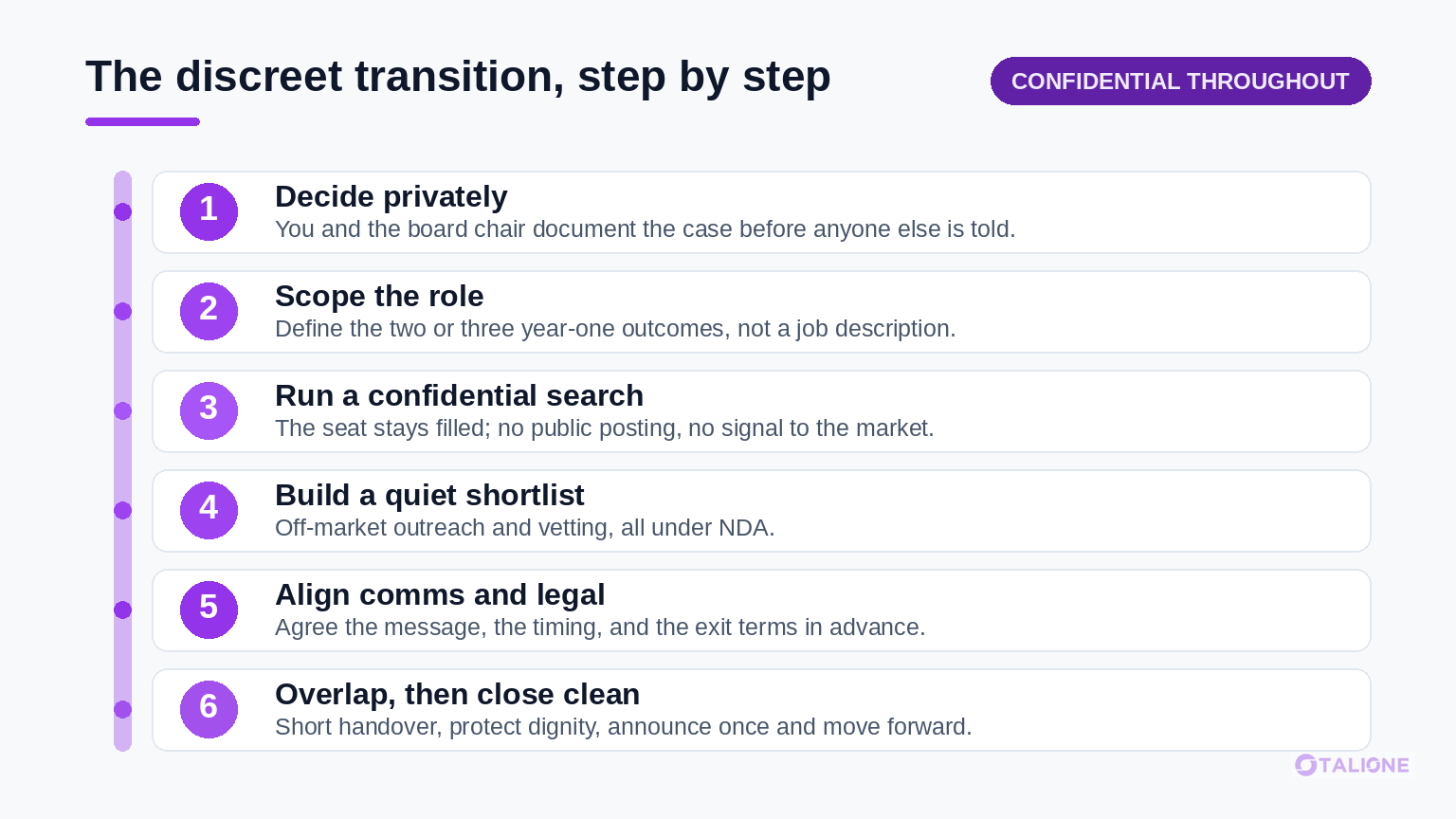
A discreet executive transition is a planned sequence, not a single dramatic event. The seat stays filled and the market stays unaware until the successor is secured and the message is set. In practice it moves through six stages:
- Decide privately. You and the board chair document the case and agree to act before anyone else is told.
- Scope the role. Define the two or three outcomes the next leader must deliver in year one, not a recycled job description.
- Run a confidential search. The seat stays filled while candidates are approached off-market with no public posting.
- Build a quiet shortlist. Vetting, interviews, and thorough reference checks all happen under NDA.
- Align comms and legal. Agree the exit terms, the message, and the timing in advance so nothing is improvised.
- Overlap, then close clean. A short handover where possible, dignity protected, and a single announcement that frames continuity.
Handled this way, the transition is almost invisible from the outside. The people who need to know learn it in the right order, the successor lands on a clear mandate, and the organisation feels stability rather than shock. That is the difference between a replacement that costs you a year and one that barely registers. It also mirrors the discipline in our principles for hiring senior talent: decide on outcomes, protect confidentiality, and never rush the close.
Frequently asked questions
How do I know it is underperformance and not just a bad quarter?
A bad quarter has a cause and a credible plan to recover. Underperformance is a pattern that survives clear, documented feedback. If the same conversation repeats across two or more quarters with no change in behaviour or results, you are past a rough patch.
Should I put the executive on a performance plan first?
Sometimes, and often for legal and fairness reasons you will. But be honest about whether it is a genuine path to improvement or a paper trail for a decision already made. If it is the latter, run your confidential search in parallel so you are not left exposed when the plan ends.
Can I really replace an executive without the market finding out?
Yes. A confidential search never uses a public posting, approaches candidates off-market under NDA, and vets the shortlist before you make any change. The incumbent stays in role and the news stays inside a small circle until you are ready to announce.
How long does a discreet executive replacement take?
Plan for the same clock as any senior search, typically a few months from scoping to a signed successor, plus time to plan the overlap and communications. Deciding early is what gives you room to run it quietly rather than in a scramble.
What do I tell the team?
As little as needed before the decision, and one clear, consistent message after. Decide the message in advance, announce once, and frame the change as continuity with the successor already in place, not as a crisis you are reacting to.
Who should know before the transition is announced?
Keep the circle very small: you, the board chair, counsel, and your search partner. Every extra person is another path for the news to leak before the successor and the message are ready.
If you are weighing a change at the top, the worst move is to wait for the situation to force your hand. Decide, then move quietly. Talk to Talione about a confidential search and line up the right successor before you change a thing.
Hiring senior talent in Canada?
Talione helps companies hire 4× faster with zero upfront costs. Let's find your next great hire.
Hire TalentRelated Posts

When Should You Hire Your First VP? A Founder's Timing Guide
Hire your first VP when you have a repeatable motion to scale, not when revenue hits a number. The readiness signals, what to prove first, and how to scope the role.